Poly(ethylene glycol) triphenylphosphine
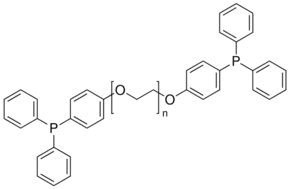
Poly(ethylene glycol) triphenylphosphine (CAS: 238403-28-6) is a specialized phosphine ligand featuring a polyethylene glycol (PEG) backbone. This structure enhances solubility and can facilitate catalyst recovery. It is primarily utilized as a catalyst or ligand in various chemical synthesis applications, particularly in hydrogenation reactions, offering advantages in biphasic systems for easier separation.
Hydrogenation Catalyst
This compound serves as an effective hydrogenation catalyst, particularly in biphasic aqueous/organic solvent systems. Its solubility characteristics aid in the separation of the catalyst from the reaction products.
Phosphine Ligand in Synthesis
As a phosphine ligand, it can coordinate with transition metals to form catalytically active species for various organic transformations. The PEG chain offers potential for improved handling and recyclability in certain synthetic methodologies.
Solid-Supported Synthesis
The polymeric nature of the PEG backbone makes this compound suitable for applications in solid-supported synthesis, enabling easier purification and repeated use in catalytic cycles.
| Application | • Used as a hydrogenation catalyst in a water/substrate two-phase medium1 |
|---|---|
| Melting point | 44-46 °C(lit.) |
| Protective equipment | Eyeshields, Gloves, type N95 (US), type P1 (EN143) respirator filter |
|---|---|
| Water hazard class (WGK, DE) | 3 |
Hazard information is provided for guidance. Always consult the product Safety Data Sheet (SDS), available on request, before handling.
Documentation
Every batch ships with a Certificate of Analysis covering assay, identity and purity; the grade is confirmed against your enquiry. Safety Data Sheets and technical data sheets are available on request.
Supply & logistics
Samples for technical evaluation; bulk MOQ by grade and packaging. In-stock material ships in 7–10 working days, worldwide, with full export documentation.
What is Poly(ethylene glycol) triphenylphosphine used for?
+
Poly(ethylene glycol) triphenylphosphine (CAS: 238403-28-6) is primarily used as a hydrogenation catalyst, particularly in two-phase systems, and as a phosphine ligand in various chemical synthesis applications.
What is the CAS number and chemical formula for Poly(ethylene glycol) triphenylphosphine?
+
The CAS number is 238403-28-6. The chemical formula is not provided in the data.
What grade and purity does Tech Serve Solutions supply?
+
Tech Serve Solutions supplies this chemical for research and development purposes. The specific assay or grade is not detailed in the provided data; it is not represented as USP, BP, EP, or other pharmacopoeia grades.
How should Poly(ethylene glycol) triphenylphosphine be handled safely?
+
Handling requires appropriate personal protective equipment, including eyeshields and gloves. A type N95 (US) or type P1 (EN143) respirator filter should be used. Refer to the Safety Data Sheet for comprehensive handling information.
How is Poly(ethylene glycol) triphenylphosphine shipped?
+
Tech Serve Solutions is a global supplier and exporter of chemicals, adhering to all relevant shipping and export regulations for hazardous materials.
How can I request a sample or quote for Poly(ethylene glycol) triphenylphosphine?
+
Please contact our sales team directly via phone or email to request a sample or a quotation for Poly(ethylene glycol) triphenylphosphine.
▶ Related products
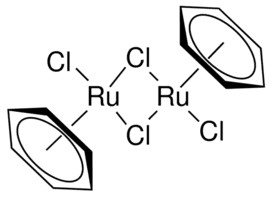
Benzeneruthenium(II) chloride dimer
Ru2(C6H6)2Cl4
Catalysis & Inorganic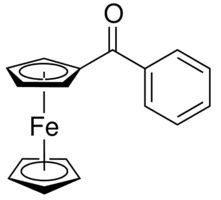
Benzoylferrocene
C17H14FeO
Catalysis & Inorganic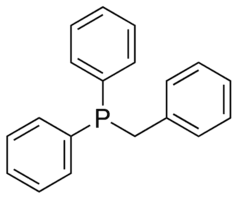
Benzyldiphenylphosphine
C6H5CH2P(C6H5)2
Catalysis & Inorganic
Beryllium
Be
Catalysis & Inorganic
Beryllium oxide
BeO
Catalysis & Inorganic![Bicyclo[2.2.1]hepta-2,5-diene-rhodium(I) chloride dimer — chemical structure, CAS 12257-42-0; Catalysis & Inorganic, fine chemical supplied by Tech Serve Solutions](/_next/image?url=https%3A%2F%2Fpub-f4d920c906024441a773a96f7098e551.r2.dev%2Fimages%2Fproducts%2F12257-42-0.png&w=3840&q=75)
Bicyclo[2.2.1]hepta-2,5-diene-rhodium(I) chloride dimer
Catalysis & Inorganic
![Bis[(10,11-η)-5-[(11bS)-dinaphtho[2,1-d:1′,2′-f][1,3,2]dioxaphosphepin-4-yl- κP4]-5H-dibenz[b,f]azepine]rhodium(I) tetrafluorobo — chemical structure, CAS 1228149-03-8; Catalysis & Inorganic, fine chemical supplied by Tech Serve Solutions](/_next/image?url=https%3A%2F%2Fpub-f4d920c906024441a773a96f7098e551.r2.dev%2Fimages%2Fproducts%2F1228149-03-8.png&w=3840&q=75)
Bis[(10,11-η)-5-[(11bS)-dinaphtho[2,1-d:1′,2′-f][1,3,2]dioxaphosphepin-4-yl- κP4]-5H-dibenz[b,f]azepine]rhodium(I) tetrafluorobo
1-d:1′
Catalysis & Inorganic![Bis[(2-dimethylamino)phenyl]amine nickel(II) chloride (C16H20ClN3Ni) — chemical structure, CAS 1033772-47-2; Catalysis & Inorganic, fine chemical supplied by Tech Serve Solutions](/_next/image?url=https%3A%2F%2Fpub-f4d920c906024441a773a96f7098e551.r2.dev%2Fimages%2Fproducts%2F1033772-47-2.png&w=3840&q=75)
Bis[(2-dimethylamino)phenyl]amine nickel(II) chloride
C16H20ClN3Ni
Catalysis & Inorganic