Di-tert-butylphenylphosphine
Di-tert-butylphenylphosphine (CAS: 32673-25-9, C14H23P) is an organophosphorus compound with a molecular weight of 222.31 g/mol. It is primarily utilized as a catalyst and cocatalyst in various cross-coupling reactions, including palladium-catalyzed processes. Its distinct phosphine structure makes it valuable in complex organic synthesis, particularly in forming carbon-carbon bonds.
- IUPAC
- NSC 244300
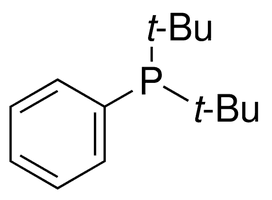
Catalysis in Cross-Coupling Reactions
This phosphine serves as a key catalyst in various cross-coupling reactions, facilitating the formation of new carbon-carbon bonds. It is particularly effective in palladium-catalyzed processes and the coupling of specific organic halides with organometallic reagents.
Palladium-Catalyzed Monoarylation
Di-tert-butylphenylphosphine functions as a crucial cocatalyst in palladium-catalyzed monoarylation reactions. This application is vital for selectively introducing aryl groups onto substrates in organic synthesis.
Coupling of Alkyl Bromides
It participates in the coupling of alkyl bromides with aryl boronic acids, a specific type of Suzuki coupling. This reaction is important for constructing complex organic molecules.
Synthesis of Palladium-FiberCats
The compound acts as a reactant in the synthesis of specialised palladium-FiberCats. These catalysts are designed for efficient Suzuki coupling reactions, notably with challenging aryl chloride substrates.
| Molecular weight | 222.31 |
|---|---|
| Empirical formula | C14H23P |
| Assay | 95% |
| Boiling point | 124-128 °C/10 mmHg |
| Density | 0.933 g/mL at 25 °C |
| Refractive index | n20/D 1.5382 |
| Application | Catalyst for:• Cross-coupling reactions1• Palladium-catalyzed monoarylation reactions (cocatalyst)2• Coupling of alkyl bromides with aryl boronic acids3• Reactant for the synthesis of palladium-FiberCats for aryl chloride Suzuki coupling4 |


Hazard statements
- H250Catches fire spontaneously if exposed to air
- H315Causes skin irritation
- H319Causes serious eye irritation
- H335May cause respiratory irritation
- H413May cause long-lasting harmful effects to aquatic life
Precautionary statements
- P222Do not allow contact with air
- P231Handle under inert gas
- P261Avoid breathing dust, fume, gas or vapours
- P305IF IN EYES
- P422
| Protective equipment | Eyeshields, Faceshields, full-face respirator (US), Gloves, multi-purpose combination respirator cartridge (US), type ABEK (EN14387) respirator filter |
|---|---|
| Transport (UN / ADR) | UN 2845 4.2 |
| Water hazard class (WGK, DE) | 3 |
| Hazard codes (EU) | F,Xi |
| Risk statements (R) | 17-36/37/38 |
| Safety statements (S) | 6-26 |
Hazard information is provided for guidance. Always consult the product Safety Data Sheet (SDS), available on request, before handling.
Documentation
Every batch ships with a Certificate of Analysis covering assay, identity and purity; the grade is confirmed against your enquiry. Safety Data Sheets and technical data sheets are available on request.
Supply & logistics
Samples for technical evaluation; bulk MOQ by grade and packaging. In-stock material ships in 7–10 working days, worldwide, with full export documentation.
What is Di-tert-butylphenylphosphine used for?
+
Di-tert-butylphenylphosphine is used as a catalyst and cocatalyst in various cross-coupling reactions, including palladium-catalyzed monoarylation and the coupling of alkyl bromides with aryl boronic acids. It is also a reactant in the synthesis of palladium-FiberCats for aryl chloride Suzuki coupling.
What are the CAS number and formula for Di-tert-butylphenylphosphine?
+
The CAS number for Di-tert-butylphenylphosphine is 32673-25-9, and its empirical formula is C14H23P.
What grade and purity does Tech Serve Solutions supply?
+
Tech Serve Solutions supplies Di-tert-butylphenylphosphine with an assay of 95%. TSS does not represent this product as USP, BP, EP, or any other pharmacopoeia grade.
What are the safety and handling considerations for Di-tert-butylphenylphosphine?
+
Di-tert-butylphenylphosphine is a flammable solid that may self-heat or ignite spontaneously if exposed to air (H250). It can cause skin irritation (H315), serious eye irritation (H319), and respiratory irritation (H335). It is harmful to aquatic life with long lasting effects (H413). Handle with appropriate personal protective equipment, including eyeshields, gloves, and a suitable respirator, in a well-ventilated area, and under an inert atmosphere.
How is Di-tert-butylphenylphosphine packed and shipped?
+
Di-tert-butylphenylphosphine is shipped as a UN 2845 (Class 4.2) substance, indicating it is a spontaneously combustible solid. It is packed and exported according to stringent international regulations for hazardous materials to ensure safe transit.
How can I request a quote or sample for Di-tert-butylphenylphosphine?
+
To request a quote or a sample of Di-tert-butylphenylphosphine, please contact our sales team through the TSS website or by phone, providing your contact details and the required quantity.
▶ Related products
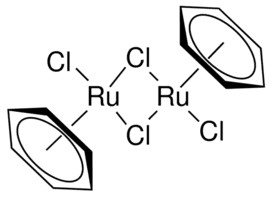
Benzeneruthenium(II) chloride dimer
Ru2(C6H6)2Cl4
Catalysis & Inorganic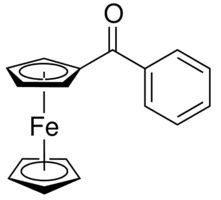
Benzoylferrocene
C17H14FeO
Catalysis & Inorganic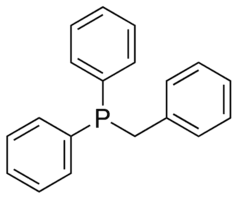
Benzyldiphenylphosphine
C6H5CH2P(C6H5)2
Catalysis & Inorganic
Beryllium
Be
Catalysis & Inorganic
Beryllium oxide
BeO
Catalysis & Inorganic![Bicyclo[2.2.1]hepta-2,5-diene-rhodium(I) chloride dimer — chemical structure, CAS 12257-42-0; Catalysis & Inorganic, fine chemical supplied by Tech Serve Solutions](/_next/image?url=https%3A%2F%2Fpub-f4d920c906024441a773a96f7098e551.r2.dev%2Fimages%2Fproducts%2F12257-42-0.png&w=3840&q=75)
Bicyclo[2.2.1]hepta-2,5-diene-rhodium(I) chloride dimer
Catalysis & Inorganic
![Bis[(10,11-η)-5-[(11bS)-dinaphtho[2,1-d:1′,2′-f][1,3,2]dioxaphosphepin-4-yl- κP4]-5H-dibenz[b,f]azepine]rhodium(I) tetrafluorobo — chemical structure, CAS 1228149-03-8; Catalysis & Inorganic, fine chemical supplied by Tech Serve Solutions](/_next/image?url=https%3A%2F%2Fpub-f4d920c906024441a773a96f7098e551.r2.dev%2Fimages%2Fproducts%2F1228149-03-8.png&w=3840&q=75)
Bis[(10,11-η)-5-[(11bS)-dinaphtho[2,1-d:1′,2′-f][1,3,2]dioxaphosphepin-4-yl- κP4]-5H-dibenz[b,f]azepine]rhodium(I) tetrafluorobo
1-d:1′
Catalysis & Inorganic![Bis[(2-dimethylamino)phenyl]amine nickel(II) chloride (C16H20ClN3Ni) — chemical structure, CAS 1033772-47-2; Catalysis & Inorganic, fine chemical supplied by Tech Serve Solutions](/_next/image?url=https%3A%2F%2Fpub-f4d920c906024441a773a96f7098e551.r2.dev%2Fimages%2Fproducts%2F1033772-47-2.png&w=3840&q=75)
Bis[(2-dimethylamino)phenyl]amine nickel(II) chloride
C16H20ClN3Ni
Catalysis & Inorganic