Bis(cyclooctadiene)iridium(I) tetrakis(3,5-bis(trifluoromethyl)phenyl)borate
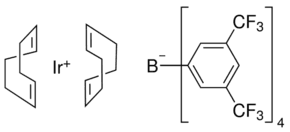
Bis(cyclooctadiene)iridium(I) tetrakis(3,5-bis(trifluoromethyl)phenyl)borate (CAS 666826-16-0) is a cationic iridium(I) organometallic precatalyst with linear formula [Ir(C8H12)2]+ [B(C8H3F6)4]- and a molar mass of 1271.79 g/mol. It pairs two 1,5-cyclooctadiene ligands on iridium with a weakly coordinating tetrakis[3,5-bis(trifluoromethyl)phenyl]borate (BArF) anion. Supplied as a research-grade reagent, it serves as a homogeneous catalyst precursor for asymmetric hydrogenation and a range of iridium-catalysed C-H functionalisation and cyclisation reactions.
- Synonyms
- Bis(cyclooctadiene)iridium(I) tetrakis(3,5-bis(trifluoromethyl)phenyl)borateBis(1,5-cyclooctadiene)iridium(I) tetrakis[3,5-bis(trifluoromethyl)phenyl]borate[Ir(COD)2]+ [BArF]-[Ir(C8H12)2]+ [B(C8H3F6)4]-Bis(1,5-cyclooctadiene)iridium(I) BArFCAS 666826-16-0
Asymmetric hydrogenation
Acts as a cationic iridium(I) precatalyst for asymmetric hydrogenation reactions, typically in combination with chiral ligands. The non-coordinating BArF anion helps maintain a reactive, well-defined cationic metal centre.
Iridium-catalysed C-H functionalisation
Used in directed C-H bond cleavage and direct prenylation via C-H oxidative addition and allene insertion. These transformations build carbon-carbon bonds while controlling site selectivity through directing groups.
Cyclisation and cyclodehydration
Promotes directed cyclodehydration reactions and double intramolecular hydroalkoxylation, supporting the construction of oxygen-containing ring systems in synthetic chemistry.
Hydroamination
Catalyses intramolecular hydroamination reactions, enabling the formation of nitrogen-containing rings through addition of N-H bonds across alkenes or related unsaturation.
Imine vinylation
Serves as a catalyst for imine vinylation reactions, a route to functionalised amine and allylamine frameworks in fine-chemical and methodology research.
| Molecular weight | 1271.79 |
|---|---|
| Linear formula | (Ir(C8H12)2)+ (B(C8H3F6)4)- |
| Application | Catalyst for:• Asymmetric hydrogenation reactions1• Directed cyclodehydration reaction2• Direct prenylation via C-H oxidative addition-allene insertion3• Double intramolecular hydroalkoxylation4• Intramolecular hydroamination reactions5• Directed C-H bond cleavage6• Imine vinylation reactions7Umicore Precatalysts for Asymmetric and Cross-Coupling Catalysis |

Hazard statements
- H315Causes skin irritation
- H319Causes serious eye irritation
- H335May cause respiratory irritation
Precautionary statements
- P261Avoid breathing dust, fume, gas or vapours
- P305IF IN EYES
| Protective equipment | dust mask type N95 (US), Eyeshields, Gloves |
|---|---|
| Water hazard class (WGK, DE) | 3 |
| Hazard codes (EU) | Xi |
| Risk statements (R) | 36/37/38 |
| Safety statements (S) | 26 |
Hazard information is provided for guidance. Always consult the product Safety Data Sheet (SDS), available on request, before handling.
Documentation
Every batch ships with a Certificate of Analysis covering assay, identity and purity; the grade is confirmed against your enquiry. Safety Data Sheets and technical data sheets are available on request.
Supply & logistics
Samples for technical evaluation; bulk MOQ by grade and packaging. In-stock material ships in 7–10 working days, worldwide, with full export documentation.
What is Bis(cyclooctadiene)iridium(I) tetrakis(3,5-bis(trifluoromethyl)phenyl)borate used for?
+
It is used as a homogeneous iridium(I) precatalyst in chemical synthesis. Documented applications include asymmetric hydrogenation, directed C-H bond cleavage, direct prenylation, directed cyclodehydration, double intramolecular hydroalkoxylation, intramolecular hydroamination and imine vinylation reactions.
What is the CAS number and molecular formula of Bis(cyclooctadiene)iridium(I) tetrakis(3,5-bis(trifluoromethyl)phenyl)borate?
+
Its CAS number is 666826-16-0 and its linear formula is [Ir(C8H12)2]+ [B(C8H3F6)4]-, comprising a bis(1,5-cyclooctadiene)iridium(I) cation and a tetrakis[3,5-bis(trifluoromethyl)phenyl]borate anion. The molecular weight is 1271.79 g/mol (MDL number MFCD10567389).
What grade and purity does Tech Serve Solutions supply?
+
Tech Serve Solutions supplies this product as a research-grade organometallic reagent intended for catalysis and synthesis. We do not represent it as USP, BP or EP pharmacopoeial grade. Batch-specific assay and certificate of analysis details are confirmed at the time of enquiry.
What are the safety and handling precautions for this compound?
+
It is classified under GHS07 with the signal word Warning and hazard statements H315 (causes skin irritation), H319 (causes serious eye irritation) and H335 (may cause respiratory irritation). Handle with a dust mask (type N95), eye protection and gloves; avoid breathing dust and rinse the eyes carefully with water if contact occurs (P261, P305+P351+P338). It is assigned Water Hazard Class WGK 3 in Germany. Always consult the Safety Data Sheet before use.
Is this product a controlled or scheduled substance?
+
Based on the supplied data, this iridium(I) catalyst is not identified as a controlled or scheduled substance. It is, however, a hazardous material for transport and handling purposes, so standard chemical safety and shipping requirements apply.
How is Bis(cyclooctadiene)iridium(I) tetrakis(3,5-bis(trifluoromethyl)phenyl)borate packed, shipped and exported?
+
It is packed in suitable sealed containers appropriate to the order quantity and labelled in line with GHS requirements. As a global supplier and exporter since 1998, Tech Serve Solutions arranges compliant documentation and international shipping; specific packaging and transport details are confirmed per destination at the time of order.
How do I request a sample or quote?
+
Contact Tech Serve Solutions with your required quantity, grade and destination, quoting CAS 666826-16-0. We will respond with availability, lead time, documentation and a formal quotation, and can discuss sample requirements where applicable.
▶ Related products
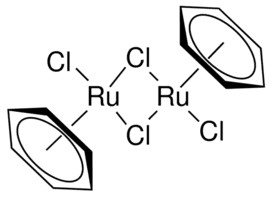
Benzeneruthenium(II) chloride dimer
Ru2(C6H6)2Cl4
Catalysis & Inorganic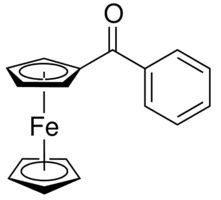
Benzoylferrocene
C17H14FeO
Catalysis & Inorganic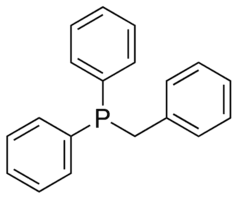
Benzyldiphenylphosphine
C6H5CH2P(C6H5)2
Catalysis & Inorganic
Beryllium
Be
Catalysis & Inorganic
Beryllium oxide
BeO
Catalysis & Inorganic![Bicyclo[2.2.1]hepta-2,5-diene-rhodium(I) chloride dimer — chemical structure, CAS 12257-42-0; Catalysis & Inorganic, fine chemical supplied by Tech Serve Solutions](/_next/image?url=https%3A%2F%2Fpub-f4d920c906024441a773a96f7098e551.r2.dev%2Fimages%2Fproducts%2F12257-42-0.png&w=3840&q=75)
Bicyclo[2.2.1]hepta-2,5-diene-rhodium(I) chloride dimer
Catalysis & Inorganic
![Bis[(10,11-η)-5-[(11bS)-dinaphtho[2,1-d:1′,2′-f][1,3,2]dioxaphosphepin-4-yl- κP4]-5H-dibenz[b,f]azepine]rhodium(I) tetrafluorobo — chemical structure, CAS 1228149-03-8; Catalysis & Inorganic, fine chemical supplied by Tech Serve Solutions](/_next/image?url=https%3A%2F%2Fpub-f4d920c906024441a773a96f7098e551.r2.dev%2Fimages%2Fproducts%2F1228149-03-8.png&w=3840&q=75)
Bis[(10,11-η)-5-[(11bS)-dinaphtho[2,1-d:1′,2′-f][1,3,2]dioxaphosphepin-4-yl- κP4]-5H-dibenz[b,f]azepine]rhodium(I) tetrafluorobo
1-d:1′
Catalysis & Inorganic![Bis[(2-dimethylamino)phenyl]amine nickel(II) chloride (C16H20ClN3Ni) — chemical structure, CAS 1033772-47-2; Catalysis & Inorganic, fine chemical supplied by Tech Serve Solutions](/_next/image?url=https%3A%2F%2Fpub-f4d920c906024441a773a96f7098e551.r2.dev%2Fimages%2Fproducts%2F1033772-47-2.png&w=3840&q=75)
Bis[(2-dimethylamino)phenyl]amine nickel(II) chloride
C16H20ClN3Ni
Catalysis & Inorganic