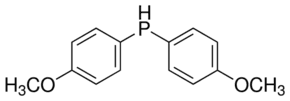
Bis(4-methoxyphenyl)phosphine
Bis(4-methoxyphenyl)phosphine (CAS 84127-04-8) is an organophosphorus compound with the molecular formula C14H15O2P and a molar mass of 246.24 g/mol. A low-melting, air-sensitive solid, it serves as a secondary phosphine building block and ligand precursor in catalysis. It is used in enantioselective iridium- and palladium-catalysed reactions and in the preparation of DIOP-type ligands for rhodium-catalysed asymmetric hydrogenation. Tech Serve Solutions supplies it as a research-grade reagent.
- Synonyms
- Bis(4-methoxyphenyl)phosphineDi(4-methoxyphenyl)phosphineBis(p-methoxyphenyl)phosphineDi(p-anisyl)phosphineBis(4-methoxyphenyl)phosphane
Enantioselective iridium-catalysed hydrogenation
Acts as a reactant and ligand precursor in iridium-catalysed asymmetric hydrogenation, where the electron-rich 4-methoxyphenyl groups help tune the steric and electronic character of the resulting phosphine ligand.
Palladium-catalysed asymmetric additions
Employed in palladium-catalysed asymmetric addition reactions, providing a secondary phosphine that can be elaborated into chiral phosphorus ligands for enantioselective bond formation.
Alkali-metal-catalysed addition reactions
Used as a reactant in alkali-metal-catalysed addition chemistry, taking advantage of the reactive P-H bond of the secondary phosphine.
Synthesis of DIOP-type ligands
Serves as a precursor in the preparation of various DIOP-type bidentate phosphine ligands applied in rhodium-catalysed asymmetric hydrogenation.
Organophosphorus building block
Functions as a general intermediate in chemical synthesis for the construction of tertiary phosphines and phosphine ligands in research and process development.
| Molecular weight | 246.24 |
|---|---|
| Empirical formula | C14H15O2P |
| Application | Reactant for:• Enantioselective Ir-catalyzed hydrogenation1• Palladium-catalyzed asymmetric additions2• Alkali-metal-catalyzed addition reactions3• Preparation of different DIOP-type ligands for uses in Rh-catalyzed asymmetric hydrogenation4 |
| Melting point | 36-40 °C |


Hazard statements
- H228Flammable solid
- H315Causes skin irritation
- H319Causes serious eye irritation
- H335May cause respiratory irritation
Precautionary statements
- P210Keep away from heat, sparks and open flames. No smoking
- P261Avoid breathing dust, fume, gas or vapours
- P305IF IN EYES
| Flash point | >110 °C / >230 °F |
|---|---|
| Transport (UN / ADR) | UN 1325 4.1 / PGII |
| Water hazard class (WGK, DE) | 3 |
| Hazard codes (EU) | F |
| Risk statements (R) | 11-36/37/38 |
| Safety statements (S) | 26-36 |
Hazard information is provided for guidance. Always consult the product Safety Data Sheet (SDS), available on request, before handling.
Documentation
Every batch ships with a Certificate of Analysis covering assay, identity and purity; the grade is confirmed against your enquiry. Safety Data Sheets and technical data sheets are available on request.
Supply & logistics
Samples for technical evaluation; bulk MOQ by grade and packaging. In-stock material ships in 7–10 working days, worldwide, with full export documentation.
What is Bis(4-methoxyphenyl)phosphine used for?
+
Bis(4-methoxyphenyl)phosphine is used primarily as a secondary phosphine reactant and ligand precursor in catalysis. Documented uses include enantioselective iridium-catalysed hydrogenation, palladium-catalysed asymmetric additions, alkali-metal-catalysed addition reactions, and the preparation of DIOP-type ligands for rhodium-catalysed asymmetric hydrogenation.
What is the CAS number and molecular formula of Bis(4-methoxyphenyl)phosphine?
+
The CAS number is 84127-04-8 and the molecular formula is C14H15O2P (Hill notation), corresponding to a molecular weight of 246.24 g/mol. The MDL number is MFCD15143653.
What grade and purity does Tech Serve Solutions supply?
+
We supply Bis(4-methoxyphenyl)phosphine as a research-grade reagent for synthesis and catalysis applications. We do not represent it as USP, BP or EP pharmacopoeia grade. Current assay and full specifications are confirmed on the certificate of analysis issued with each batch; please request the latest documentation when enquiring.
What are the safety and handling requirements for Bis(4-methoxyphenyl)phosphine?
+
It is classified under GHS02 and GHS07 with the signal word Warning. The hazard statements are H228 (flammable solid), H315 (causes skin irritation), H319 (causes serious eye irritation) and H335 (may cause respiratory irritation). As a secondary phosphine it is air-sensitive, so handle under inert gas away from ignition sources, with suitable gloves, eye protection and ventilation (P210, P261, P305+P351+P338). Always consult the SDS before use.
How is Bis(4-methoxyphenyl)phosphine packed, shipped and exported?
+
It is packed in appropriately sealed, labelled containers suited to an air-sensitive flammable solid, typically under inert atmosphere. For transport it is classified as UN 1325, Class 4.1, Packing Group II, and is shipped in compliance with applicable dangerous-goods regulations. Tech Serve Solutions exports worldwide with full documentation; pack sizes are confirmed at the time of enquiry.
How do I request a sample or quote?
+
Contact Tech Serve Solutions with your required quantity, packaging and destination, and we will provide a quotation together with available specification and safety documentation. Sample availability is confirmed on request.
▶ Related products

Benzeneruthenium(II) chloride dimer
Ru2(C6H6)2Cl4
Catalysis & Inorganic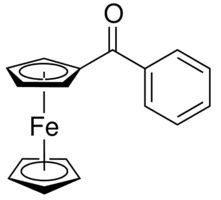
Benzoylferrocene
C17H14FeO
Catalysis & Inorganic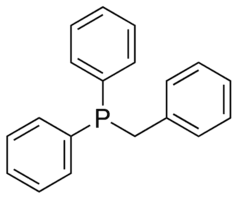
Benzyldiphenylphosphine
C6H5CH2P(C6H5)2
Catalysis & Inorganic
Beryllium
Be
Catalysis & Inorganic
Beryllium oxide
BeO
Catalysis & Inorganic![Bicyclo[2.2.1]hepta-2,5-diene-rhodium(I) chloride dimer — chemical structure, CAS 12257-42-0; Catalysis & Inorganic, fine chemical supplied by Tech Serve Solutions](/_next/image?url=https%3A%2F%2Fpub-f4d920c906024441a773a96f7098e551.r2.dev%2Fimages%2Fproducts%2F12257-42-0.png&w=3840&q=75)
Bicyclo[2.2.1]hepta-2,5-diene-rhodium(I) chloride dimer
Catalysis & Inorganic
![Bis[(10,11-η)-5-[(11bS)-dinaphtho[2,1-d:1′,2′-f][1,3,2]dioxaphosphepin-4-yl- κP4]-5H-dibenz[b,f]azepine]rhodium(I) tetrafluorobo — chemical structure, CAS 1228149-03-8; Catalysis & Inorganic, fine chemical supplied by Tech Serve Solutions](/_next/image?url=https%3A%2F%2Fpub-f4d920c906024441a773a96f7098e551.r2.dev%2Fimages%2Fproducts%2F1228149-03-8.png&w=3840&q=75)
Bis[(10,11-η)-5-[(11bS)-dinaphtho[2,1-d:1′,2′-f][1,3,2]dioxaphosphepin-4-yl- κP4]-5H-dibenz[b,f]azepine]rhodium(I) tetrafluorobo
1-d:1′
Catalysis & Inorganic![Bis[(2-dimethylamino)phenyl]amine nickel(II) chloride (C16H20ClN3Ni) — chemical structure, CAS 1033772-47-2; Catalysis & Inorganic, fine chemical supplied by Tech Serve Solutions](/_next/image?url=https%3A%2F%2Fpub-f4d920c906024441a773a96f7098e551.r2.dev%2Fimages%2Fproducts%2F1033772-47-2.png&w=3840&q=75)
Bis[(2-dimethylamino)phenyl]amine nickel(II) chloride
C16H20ClN3Ni
Catalysis & Inorganic