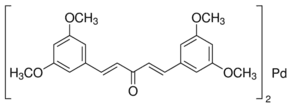
Bis(3,5,3′,5′-dimethoxydibenzylideneacetone)palladium(0)
Bis(3,5,3′,5′-dimethoxydibenzylideneacetone)palladium(0), CAS 811862-77-8, is a homogeneous palladium(0) complex with the empirical formula C42H44O10Pd and a molecular weight of 815.21. Abbreviated Pd(dmdba)2, it bears electron-rich dimethoxy-substituted dibenzylideneacetone ligands and serves as a well-defined, labile source of zero-valent palladium for catalysis. Tech Serve Solutions supplies it as a research-grade reagent (assay 96%) for cross-coupling and related synthesis. It is offered for laboratory and manufacturing research use.
- IUPAC
- Pd(dmdba)2
- Synonyms
- Bis(3,5,3′,5′-dimethoxydibenzylideneacetone)palladium(0)Pd(dmdba)2Bis(3,5,3',5'-dimethoxydibenzylideneacetone)palladiumPd(0) bis(3,5,3',5'-tetramethoxydibenzylideneacetone)CAS 811862-77-8MFCD07369799
Palladium(0) source for catalysis
Pd(dmdba)2 acts as a labile, well-defined source of zero-valent palladium. Its weakly coordinating dibenzylideneacetone ligands are readily displaced by phosphines, N-heterocyclic carbenes and other ligands to generate active catalytic species in situ.
Cross-coupling reactions
As a dba-type Pd(0) complex it is used in homogeneous palladium-catalysed carbon–carbon and carbon–heteroatom bond formation, including couplings of the Suzuki, Heck, Negishi, Stille and Buchwald–Hartwig families when paired with a suitable ligand.
Catalyst and ligand-screening studies
The electron-rich dimethoxy-substituted dba ligands make this complex a useful precursor for methodology development and for screening ligand and base combinations in homogeneous palladium catalysis.
Fine-chemical and pharmaceutical intermediate synthesis
Defined Pd(0) precursors of this type support the construction of biaryl, amine and other motifs common to pharmaceutical intermediates and advanced fine chemicals at research and process-development scale.
| Molecular weight | 815.21 |
|---|---|
| Empirical formula | C42H44O10Pd |
| Assay | 96% |
| Melting point | 170-178 °C(lit.) |

Hazard statements
- H315Causes skin irritation
- H319Causes serious eye irritation
- H335May cause respiratory irritation
Precautionary statements
- P261Avoid breathing dust, fume, gas or vapours
- P305IF IN EYES
| Protective equipment | dust mask type N95 (US), Eyeshields, Gloves |
|---|---|
| Water hazard class (WGK, DE) | 3 |
| Hazard codes (EU) | Xi |
| Risk statements (R) | 36/37/38 |
| Safety statements (S) | 26-36 |
Hazard information is provided for guidance. Always consult the product Safety Data Sheet (SDS), available on request, before handling.
Documentation
Every batch ships with a Certificate of Analysis covering assay, identity and purity; the grade is confirmed against your enquiry. Safety Data Sheets and technical data sheets are available on request.
Supply & logistics
Samples for technical evaluation; bulk MOQ by grade and packaging. In-stock material ships in 7–10 working days, worldwide, with full export documentation.
What is Bis(3,5,3′,5′-dimethoxydibenzylideneacetone)palladium(0) used for?
+
It is used as a homogeneous palladium(0) catalyst and as a well-defined source of zero-valent palladium. The dibenzylideneacetone ligands are easily displaced by added ligands to form active species for palladium-catalysed cross-coupling and related bond-forming reactions.
What is the CAS number and molecular formula of Bis(3,5,3′,5′-dimethoxydibenzylideneacetone)palladium(0)?
+
Its CAS number is 811862-77-8. The empirical formula is C42H44O10Pd (Hill notation) with a molecular weight of 815.21. It is also known by the abbreviation Pd(dmdba)2 and carries MDL number MFCD07369799.
What grade and purity does Tech Serve Solutions supply?
+
Tech Serve Solutions supplies this palladium(0) complex as a research-grade reagent with a typical assay of 96% and a reported melting point of 170–178 °C. It is offered for laboratory and manufacturing research use; we do not represent it as a USP, BP or EP pharmacopoeial grade.
What are the safety and handling requirements?
+
The material is classified GHS07 with the signal word Warning and hazard statements H315 (causes skin irritation), H319 (causes serious eye irritation) and H335 (may cause respiratory irritation). Avoid dust formation, use an N95-type dust mask, eyeshields and gloves, and handle with adequate ventilation. It carries German Water Hazard Class WGK 3, so prevent release to drains and the environment.
How is Bis(3,5,3′,5′-dimethoxydibenzylideneacetone)palladium(0) packed, shipped and exported?
+
It is supplied in tightly sealed containers with sizes matched to your requirement, labelled in line with GHS. As a global supplier and exporter, Tech Serve Solutions arranges documentation, including a Safety Data Sheet and Certificate of Analysis, and compliant transport for international shipments.
How do I request a sample or quote?
+
Contact Tech Serve Solutions with your required quantity, packaging and destination, and our team will respond with availability, lead time and a formal quotation. Samples can be discussed for qualification subject to availability.
▶ Related products
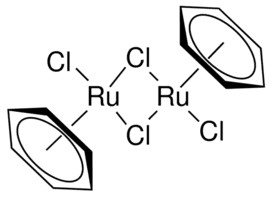
Benzeneruthenium(II) chloride dimer
Ru2(C6H6)2Cl4
Catalysis & Inorganic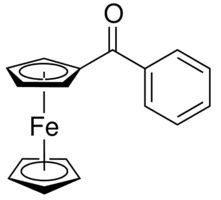
Benzoylferrocene
C17H14FeO
Catalysis & Inorganic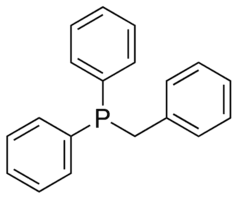
Benzyldiphenylphosphine
C6H5CH2P(C6H5)2
Catalysis & Inorganic
Beryllium
Be
Catalysis & Inorganic
Beryllium oxide
BeO
Catalysis & Inorganic![Bicyclo[2.2.1]hepta-2,5-diene-rhodium(I) chloride dimer — chemical structure, CAS 12257-42-0; Catalysis & Inorganic, fine chemical supplied by Tech Serve Solutions](/_next/image?url=https%3A%2F%2Fpub-f4d920c906024441a773a96f7098e551.r2.dev%2Fimages%2Fproducts%2F12257-42-0.png&w=3840&q=75)
Bicyclo[2.2.1]hepta-2,5-diene-rhodium(I) chloride dimer
Catalysis & Inorganic
![Bis[(10,11-η)-5-[(11bS)-dinaphtho[2,1-d:1′,2′-f][1,3,2]dioxaphosphepin-4-yl- κP4]-5H-dibenz[b,f]azepine]rhodium(I) tetrafluorobo — chemical structure, CAS 1228149-03-8; Catalysis & Inorganic, fine chemical supplied by Tech Serve Solutions](/_next/image?url=https%3A%2F%2Fpub-f4d920c906024441a773a96f7098e551.r2.dev%2Fimages%2Fproducts%2F1228149-03-8.png&w=3840&q=75)
Bis[(10,11-η)-5-[(11bS)-dinaphtho[2,1-d:1′,2′-f][1,3,2]dioxaphosphepin-4-yl- κP4]-5H-dibenz[b,f]azepine]rhodium(I) tetrafluorobo
1-d:1′
Catalysis & Inorganic![Bis[(2-dimethylamino)phenyl]amine nickel(II) chloride (C16H20ClN3Ni) — chemical structure, CAS 1033772-47-2; Catalysis & Inorganic, fine chemical supplied by Tech Serve Solutions](/_next/image?url=https%3A%2F%2Fpub-f4d920c906024441a773a96f7098e551.r2.dev%2Fimages%2Fproducts%2F1033772-47-2.png&w=3840&q=75)
Bis[(2-dimethylamino)phenyl]amine nickel(II) chloride
C16H20ClN3Ni
Catalysis & Inorganic