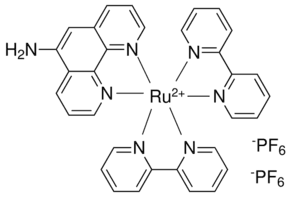
Bis(2,2′-bipyridine)-(5-aminophenanthroline)ruthenium bis(hexafluorophosphate)
Bis(2,2′-bipyridine)-(5-aminophenanthroline)ruthenium bis(hexafluorophosphate) (CAS 84537-86-0; formula C32H25N7Ru·2PF6; molar mass 898.59) is a luminescent ruthenium(II) polypyridyl complex isolated as a bis(hexafluorophosphate) salt. Its 5-amino-1,10-phenanthroline ligand carries a reactive primary amine for bioconjugation, while the chromophore gives characteristic metal-to-ligand charge-transfer emission (λex 458 nm, λem 612 nm). Tech Serve Solutions supplies it as a BioReagent-grade research reagent for fluorescence labelling and photoinduced electron-transfer studies.
- IUPAC
- Ru(bpy)2(phen-5-NH2)(PF6)2
- Synonyms
- Ru(bpy)2(phen-5-NH2)(PF6)2Bis(2,2′-bipyridine)(5-amino-1,10-phenanthroline)ruthenium(II) bis(hexafluorophosphate)(5-Amino-1,10-phenanthroline)bis(2,2′-bipyridine)ruthenium(II) hexafluorophosphate[Ru(bpy)2(5-aminophen)](PF6)2C32H25N7Ru · 2 PF6
Fluorescent labelling and bioconjugation
The primary amine on the 5-aminophenanthroline ligand provides a handle for covalently coupling the ruthenium centre to peptides, proteins and other biomolecules. The resulting conjugates are detected through the complex's characteristic luminescence (λem 612 nm), making it suitable for fluorescence-based assays.
Photoinduced electron-transfer research
It is used to study photoinduced intramolecular electron transfer in peptide-bridged molecules and related donor-acceptor systems. The well-defined excited-state behaviour of the ruthenium(II) chromophore makes it a useful probe for photophysical investigations.
Visible-light photochemistry and photosensitisation
As a ruthenium(II) polypyridyl complex it absorbs visible light and is applied in photochemical and photophysical studies. The broader Ru(bpy)-based family is widely employed as visible-light photosensitisers in photoredox chemistry.
Building block for functionalised metal complexes
The reactive amine and stable hexafluorophosphate salt make the compound a versatile starting point for preparing labelled biomolecules and more elaborate ruthenium-based assemblies in inorganic and supramolecular synthesis.
| Molecular weight | 898.59 |
|---|---|
| Empirical formula | C32H25N7Ru · 2 PF6 |
| Storage temperature | −20°C |
| Application | Used for photoinduced intramolecular electron transfer in peptide-bridged molecules. |
| Suitability | suitable for fluorescence |
| Protective equipment | Eyeshields, Gloves, type N95 (US), type P1 (EN143) respirator filter |
|---|---|
| Water hazard class (WGK, DE) | 3 |
Hazard information is provided for guidance. Always consult the product Safety Data Sheet (SDS), available on request, before handling.
| Product Line | BioReagent |
|---|---|
| Fluorescence | λex 458 nm; λem 612 nm in 0.1 M Tris pH 7.0 |
Documentation
Every batch ships with a Certificate of Analysis covering assay, identity and purity; the grade is confirmed against your enquiry. Safety Data Sheets and technical data sheets are available on request.
Supply & logistics
Samples for technical evaluation; bulk MOQ by grade and packaging. In-stock material ships in 7–10 working days, worldwide, with full export documentation.
What is Bis(2,2′-bipyridine)-(5-aminophenanthroline)ruthenium bis(hexafluorophosphate) used for?
+
It is a luminescent ruthenium(II) polypyridyl complex used mainly as a fluorescent label and bioconjugation reagent, and in photoinduced electron-transfer and photochemical research. The amine on its 5-aminophenanthroline ligand allows attachment to peptides and other biomolecules, and the supplied material is intended for laboratory and research use.
What is the CAS number and molecular formula of this ruthenium complex?
+
The CAS number is 84537-86-0. The empirical formula in Hill notation is C32H25N7Ru·2PF6 (consolidated molecular formula C32H25F12N7P2Ru), with a molar mass of 898.59 g/mol and MDL number MFCD20921517. It is commonly abbreviated Ru(bpy)2(phen-5-NH2)(PF6)2.
What grade and purity does Tech Serve Solutions supply?
+
Tech Serve Solutions supplies this compound as a BioReagent-grade research reagent suitable for fluorescence applications. Lot-specific assay and specification details are confirmed on the certificate of analysis supplied with each batch. We do not represent it as USP, BP, EP, pharmacopoeia or food grade; it is offered for research and laboratory use only.
What are its fluorescence excitation and emission wavelengths?
+
The complex is excited at λex 458 nm and emits at λem 612 nm, measured in 0.1 M Tris buffer at pH 7.0. This long-wavelength emission arises from the characteristic metal-to-ligand charge-transfer luminescence of ruthenium(II) polypyridyl chromophores and supports its use in fluorescence detection.
How should this compound be handled and stored safely?
+
Handle it as a research chemical under good laboratory practice. The supplied data does not include a full GHS classification, so always consult the current Safety Data Sheet before use. Recommended personal protective equipment is eye protection, gloves and a particulate respirator (N95 / EN 143 type P1). It is classified WGK 3 in Germany (highly hazardous to water), so prevent any release to drains or the environment. Store at −20 °C.
How is this product packed, shipped and exported?
+
It is packed in sealed, appropriately labelled containers sized to the order, with quantities from research scale upwards. Because the recommended storage temperature is −20 °C, it is handled and despatched with suitable cold-chain protection. Each shipment is accompanied by a Safety Data Sheet and certificate of analysis, and Tech Serve Solutions prepares the export documentation required for the destination country.
How do I request a sample or quote?
+
Contact Tech Serve Solutions with the quantity and intended application, and we will provide a quotation and, where appropriate, a sample. Please state your delivery destination so we can confirm packing, lead time and the necessary export documentation.
▶ Related products
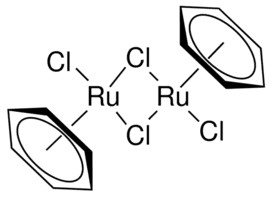
Benzeneruthenium(II) chloride dimer
Ru2(C6H6)2Cl4
Catalysis & Inorganic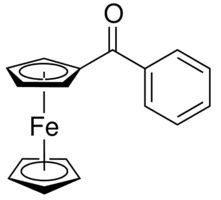
Benzoylferrocene
C17H14FeO
Catalysis & Inorganic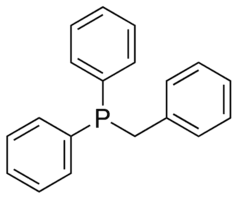
Benzyldiphenylphosphine
C6H5CH2P(C6H5)2
Catalysis & Inorganic
Beryllium
Be
Catalysis & Inorganic
Beryllium oxide
BeO
Catalysis & Inorganic![Bicyclo[2.2.1]hepta-2,5-diene-rhodium(I) chloride dimer — chemical structure, CAS 12257-42-0; Catalysis & Inorganic, fine chemical supplied by Tech Serve Solutions](/_next/image?url=https%3A%2F%2Fpub-f4d920c906024441a773a96f7098e551.r2.dev%2Fimages%2Fproducts%2F12257-42-0.png&w=3840&q=75)
Bicyclo[2.2.1]hepta-2,5-diene-rhodium(I) chloride dimer
Catalysis & Inorganic
![Bis[(10,11-η)-5-[(11bS)-dinaphtho[2,1-d:1′,2′-f][1,3,2]dioxaphosphepin-4-yl- κP4]-5H-dibenz[b,f]azepine]rhodium(I) tetrafluorobo — chemical structure, CAS 1228149-03-8; Catalysis & Inorganic, fine chemical supplied by Tech Serve Solutions](/_next/image?url=https%3A%2F%2Fpub-f4d920c906024441a773a96f7098e551.r2.dev%2Fimages%2Fproducts%2F1228149-03-8.png&w=3840&q=75)
Bis[(10,11-η)-5-[(11bS)-dinaphtho[2,1-d:1′,2′-f][1,3,2]dioxaphosphepin-4-yl- κP4]-5H-dibenz[b,f]azepine]rhodium(I) tetrafluorobo
1-d:1′
Catalysis & Inorganic![Bis[(2-dimethylamino)phenyl]amine nickel(II) chloride (C16H20ClN3Ni) — chemical structure, CAS 1033772-47-2; Catalysis & Inorganic, fine chemical supplied by Tech Serve Solutions](/_next/image?url=https%3A%2F%2Fpub-f4d920c906024441a773a96f7098e551.r2.dev%2Fimages%2Fproducts%2F1033772-47-2.png&w=3840&q=75)
Bis[(2-dimethylamino)phenyl]amine nickel(II) chloride
C16H20ClN3Ni
Catalysis & Inorganic