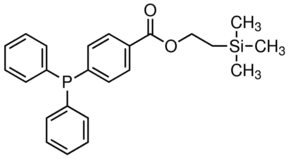
4-Diphenylphosphanylbenzoic acid, 2-(trimethylsilyl)ethyl ester solution
4-Diphenylphosphanylbenzoic acid, 2-(trimethylsilyl)ethyl ester solution (CAS 566190-45-2) is a chemical compound with a molecular weight of 406.53 g/mol. Supplied as a 0.5 M solution in THF, this organophosphorus compound serves as a valuable reagent in organic synthesis. Its primary applications include the synthesis of alkenes, methylation of aldehydes, and participation in Mitsunobu reactions, making it a useful tool for chemists.
- Synonyms
- C24H27O2PSi4-Diphenylphosphanylbenzoic acid, 2-(trimethylsilyl)ethyl ester566190-45-2
Synthesis of Alkenes
This compound is employed as a reagent in the synthesis of alkenes, a fundamental transformation in organic chemistry. It facilitates the formation of carbon-carbon double bonds.
Methylation of Aldehydes
The reagent can be utilised for the methylation of aldehydes. This application allows for the introduction of a methyl group onto aldehyde functionalities, extending carbon chains.
Mitsunobu Reactions
It is recognised for its utility in performing Mitsunobu reactions. This versatile reaction enables the inversion of stereochemistry or functional group interconversion under mild conditions.
| Molecular weight | 406.53 |
|---|---|
| Empirical formula | C24H27O2PSi |
| Density | 0.925 g/mL at 25 °C |
| Concentration | 0.5 M in THF |
| Application | Reagent for:• Synthesis of alkenes1• Methylation of aldehydes2• Mitsunobu reactions3 |


Hazard statements
- H225Highly flammable liquid and vapour
- H319Causes serious eye irritation
- H335May cause respiratory irritation
- H351Suspected of causing cancer
Precautionary statements
- P210Keep away from heat, sparks and open flames. No smoking
- P261Avoid breathing dust, fume, gas or vapours
- P281Use personal protective equipment as required
- P305IF IN EYES
| Flash point | -20 °C / -4 °F |
|---|---|
| Transport (UN / ADR) | UN 2056 3 / PGII |
| Water hazard class (WGK, DE) | 3 |
| Hazard codes (EU) | F,Xn |
| Risk statements (R) | 11-19-36/37-40 |
| Safety statements (S) | 16-26-36/37 |
| Supplemental hazards | May form explosive peroxides. |
Hazard information is provided for guidance. Always consult the product Safety Data Sheet (SDS), available on request, before handling.
Documentation
Every batch ships with a Certificate of Analysis covering assay, identity and purity; the grade is confirmed against your enquiry. Safety Data Sheets and technical data sheets are available on request.
Supply & logistics
Samples for technical evaluation; bulk MOQ by grade and packaging. In-stock material ships in 7–10 working days, worldwide, with full export documentation.
What is 4-Diphenylphosphanylbenzoic acid, 2-(trimethylsilyl)ethyl ester solution used for?
+
This compound is used as a reagent in organic synthesis, specifically for the synthesis of alkenes, the methylation of aldehydes, and in Mitsunobu reactions.
What are the CAS number and molecular formula?
+
The CAS number is 566190-45-2, and the empirical formula (Hill notation) is C24H27O2PSi. The molecular weight is 406.53 g/mol.
What grade and purity does Tech Serve Solutions supply?
+
Tech Serve Solutions supplies this product as a 0.5 M solution in THF. We do not claim USP, BP, EP, or other pharmacopoeia grades unless explicitly stated in the product specifications. It is suitable for research and general laboratory use.
What are the safety and handling considerations?
+
This product is a Danger hazard, classified under GHS02, GHS07, GHS08, with hazards including H225 (Highly flammable liquid and vapour), H319 (Causes serious eye irritation), H335 (May cause respiratory irritation), and H351 (Suspected of causing cancer). It may also form explosive peroxides. Handle with appropriate personal protective equipment in a well-ventilated area, away from ignition sources. Keep container tightly closed and grounded. Store in a cool, dry place. Refer to the Safety Data Sheet (SDS) for full details.
How is this product packed, shipped, and exported?
+
This product is supplied in appropriate packaging suitable for its hazardous nature and is exported globally by Tech Serve Solutions in compliance with international shipping regulations.
How can I request a sample or quote?
+
To request a sample or a quote, please use the contact form on the Tech Serve Solutions website or contact our sales department directly.
▶ Related products
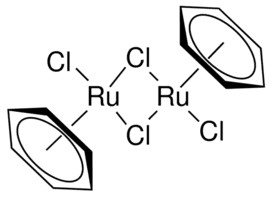
Benzeneruthenium(II) chloride dimer
Ru2(C6H6)2Cl4
Catalysis & Inorganic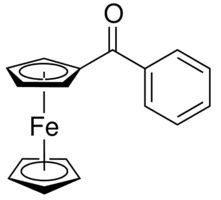
Benzoylferrocene
C17H14FeO
Catalysis & Inorganic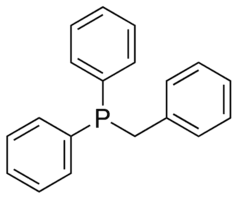
Benzyldiphenylphosphine
C6H5CH2P(C6H5)2
Catalysis & Inorganic
Beryllium
Be
Catalysis & Inorganic
Beryllium oxide
BeO
Catalysis & Inorganic![Bicyclo[2.2.1]hepta-2,5-diene-rhodium(I) chloride dimer — chemical structure, CAS 12257-42-0; Catalysis & Inorganic, fine chemical supplied by Tech Serve Solutions](/_next/image?url=https%3A%2F%2Fpub-f4d920c906024441a773a96f7098e551.r2.dev%2Fimages%2Fproducts%2F12257-42-0.png&w=3840&q=75)
Bicyclo[2.2.1]hepta-2,5-diene-rhodium(I) chloride dimer
Catalysis & Inorganic
![Bis[(10,11-η)-5-[(11bS)-dinaphtho[2,1-d:1′,2′-f][1,3,2]dioxaphosphepin-4-yl- κP4]-5H-dibenz[b,f]azepine]rhodium(I) tetrafluorobo — chemical structure, CAS 1228149-03-8; Catalysis & Inorganic, fine chemical supplied by Tech Serve Solutions](/_next/image?url=https%3A%2F%2Fpub-f4d920c906024441a773a96f7098e551.r2.dev%2Fimages%2Fproducts%2F1228149-03-8.png&w=3840&q=75)
Bis[(10,11-η)-5-[(11bS)-dinaphtho[2,1-d:1′,2′-f][1,3,2]dioxaphosphepin-4-yl- κP4]-5H-dibenz[b,f]azepine]rhodium(I) tetrafluorobo
1-d:1′
Catalysis & Inorganic![Bis[(2-dimethylamino)phenyl]amine nickel(II) chloride (C16H20ClN3Ni) — chemical structure, CAS 1033772-47-2; Catalysis & Inorganic, fine chemical supplied by Tech Serve Solutions](/_next/image?url=https%3A%2F%2Fpub-f4d920c906024441a773a96f7098e551.r2.dev%2Fimages%2Fproducts%2F1033772-47-2.png&w=3840&q=75)
Bis[(2-dimethylamino)phenyl]amine nickel(II) chloride
C16H20ClN3Ni
Catalysis & Inorganic