
N10-(Trifluoroacetyl)pteroic acid
N10-(Trifluoroacetyl)pteroic acid (CAS 37793-53-6), with the molecular formula C16H11F3N6O4, is a specialised chemical building block. It is primarily utilised in chemical synthesis and the development of heterocyclic compounds. Its structure lends itself to advanced research applications, particularly within the quinazoline class of molecules. This compound is supplied by TSS with an assay of 95%, suitable for rigorous laboratory and industrial research.
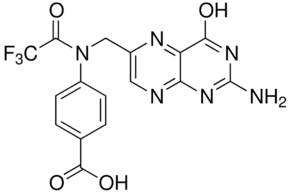
Chemical Synthesis
Serves as a key intermediate or building block in complex organic synthesis pathways. Its trifluoroacetyl group offers unique reactivity for molecular modification.
Heterocyclic Chemistry
Integral to the construction of novel heterocyclic systems, particularly those within the quinazoline family. Facilitates the exploration of diverse chemical space.
Research and Development
Employed in academic and industrial R&D settings for the discovery and development of new chemical entities. Supports advanced materials science and medicinal chemistry investigations.
| Molecular weight | 408.29 |
|---|---|
| Empirical formula | C16H11F3N6O4 |
| Assay | 95% |
| Melting point | 270 °C (dec.)(lit.) |


Hazard statements
- H302Harmful if swallowed
- H312Harmful in contact with skin
- H315Causes skin irritation
- H319Causes serious eye irritation
- H332Harmful if inhaled
- H335May cause respiratory irritation
- H350May cause cancer
Precautionary statements
- P201Obtain special instructions before use
- P261Avoid breathing dust, fume, gas or vapours
- P280Wear protective gloves, clothing and eye/face protection
- P305IF IN EYES
- P308IF exposed or concerned
| Protective equipment | Eyeshields, full-face particle respirator type N100 (US), Gloves, respirator cartridge type N100 (US), type P1 (EN143) respirator filter, type P3 (EN 143) respirator cartridges |
|---|---|
| Transport (UN / ADR) | UN 2811 6.1/PG 3 |
| Water hazard class (WGK, DE) | 3 |
| Hazard codes (EU) | T |
| Risk statements (R) | 45-20/21/22-36/37/38 |
| Safety statements (S) | 53-22-26-36/37/39-45 |
Hazard information is provided for guidance. Always consult the product Safety Data Sheet (SDS), available on request, before handling.
Documentation
Every batch ships with a Certificate of Analysis covering assay, identity and purity; the grade is confirmed against your enquiry. Safety Data Sheets and technical data sheets are available on request.
Supply & logistics
Samples for technical evaluation; bulk MOQ by grade and packaging. In-stock material ships in 7–10 working days, worldwide, with full export documentation.
What is N10-(Trifluoroacetyl)pteroic acid used for?
+
N10-(Trifluoroacetyl)pteroic acid is primarily used as a building block in chemical synthesis, particularly for creating heterocyclic compounds such as quinazolines in research and development settings.
What are the CAS number and molecular formula?
+
The CAS number for N10-(Trifluoroacetyl)pteroic acid is 37793-53-6, and its molecular formula is C16H11F3N6O4.
What grade and purity does Tech Serve Solutions supply?
+
Tech Serve Solutions supplies N10-(Trifluoroacetyl)pteroic acid with an assay of 95%. TSS does not represent this product as USP, BP, or EP grade; it is intended for research and technical use.
What are the main safety concerns when handling this chemical?
+
This compound is classified with GHS07 and GHS08 symbols, indicating danger. It carries hazard statements including H302, H312, H315, H319, H332, H335, and H350, signifying it is harmful if swallowed, in contact with skin, causes skin and eye irritation, is harmful if inhaled, may cause respiratory irritation, and may cause cancer. Appropriate personal protective equipment, including eyeshields, gloves, and respiratory protection (type N100 or P3), must be used.
How is this product packaged and shipped?
+
N10-(Trifluoroacetyl)pteroic acid is packaged and shipped in compliance with UN 2811, 6.1/PG 3 regulations, suitable for global export by TSS.
How can I request a quote or sample?
+
To request a quote or a sample of N10-(Trifluoroacetyl)pteroic acid, please contact our sales team through the TSS website or via direct inquiry.
▶ Related products

4-Amino-2-chloropyridine
C5H5ClN2
Heterocyclic Building Blocks
4-Ethynyl-1-methyl-1H-pyrazole
C6H6N2
Heterocyclic Building Blocks
4-Hydroxyquinoline-3-carboxylic acid ethyl ester
C12H11NO3
Heterocyclic Building Blocks
4-isocyanatopyridine
C6H4N2O
Heterocyclic Building Blocks
5-Chloro-2,8-dimethylquinoline
Heterocyclic Building Blocks

5-Chloro-2-methylene-1,3,3-trimethylindoline
Heterocyclic Building Blocks

5-Chloro-2-thiophenecarbonitrile
Heterocyclic Building Blocks

5-ethynyl-1H-pyrazole
C5H4N2
Heterocyclic Building Blocks▶ Explore more

Bis(cyclopentadienyl)cobalt(III) hexafluorophosphate
C10H10CoF6P
Catalysis & Inorganic
1-(4-Chlorophenyl)biguanide hydrochloride
ClC6H4NHC(NH)NHC(NH)NH2 · HCl
Chemical Synthesis
Bis(cyclopentadienyl)dimethylzirconium(IV)
Catalysis & Inorganic

1-(4-Chlorophenyl)ethanol
ClC6H4CH(CH3)OH
Chemical Synthesis