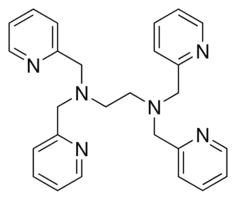
N,N,N′,N′-Tetrakis(2-pyridylmethyl)ethylenediamine
N,N,N′,N′-Tetrakis(2-pyridylmethyl)ethylenediamine (CAS 16858-02-9), widely known as TPEN, is a polydentate pyridyl ethylenediamine chelating ligand with the molecular formula C26H28N6 and a molar mass of 424.54 g/mol. Supplied as a solid melting at 110–112 °C, it is a cell-permeable, high-affinity chelator of zinc and other transition-metal ions, used principally as a research reagent in cell biology, coordination chemistry and metalloenzyme studies. Tech Serve Solutions supplies it worldwide for laboratory and synthesis use.
- IUPAC
- TPEN
- Synonyms
- TPENN,N,N′,N′-Tetrakis(2-pyridylmethyl)ethylenediamineN,N,N′,N′-Tetrakis(2-pyridinylmethyl)-1,2-ethanediamineTetrakis(2-pyridylmethyl)ethylenediamineCAS 16858-02-9C26H28N6
Intracellular zinc chelation
TPEN is a cell-permeable, high-affinity chelator widely used to sequester intracellular zinc and probe the role of labile Zn2+ in cellular signalling, enzyme activity and cell biology research.
Transition-metal coordination chemistry
Its four pyridyl nitrogen donors and ethylenediamine backbone make it a versatile hexadentate ligand for forming and studying complexes with zinc, iron, copper and other transition metals.
Metalloenzyme and metal-buffering studies
Researchers use TPEN to selectively remove or buffer trace transition-metal ions in biochemical systems, helping to characterise metal-dependent enzymes and metalloprotein function.
Chemical synthesis building block
As a heterocyclic, pyridine-based building block it serves in the preparation of designed coordination compounds and related ligand frameworks for synthetic and inorganic chemistry programmes.
| Molecular weight | 424.54 |
|---|---|
| Empirical formula | C26H28N6 |
| Assay | ≥98.0% (NT) |
| Melting point | 110-112 °C |

Hazard statements
- H315Causes skin irritation
- H319Causes serious eye irritation
- H335May cause respiratory irritation
Precautionary statements
- P261Avoid breathing dust, fume, gas or vapours
- P305IF IN EYES
| Protective equipment | dust mask type N95 (US), Eyeshields, Gloves |
|---|---|
| Water hazard class (WGK, DE) | 3 |
| Hazard codes (EU) | Xi |
| Risk statements (R) | 36/37/38 |
| Safety statements (S) | 26-36 |
Hazard information is provided for guidance. Always consult the product Safety Data Sheet (SDS), available on request, before handling.
Documentation
Every batch ships with a Certificate of Analysis covering assay, identity and purity; the grade is confirmed against your enquiry. Safety Data Sheets and technical data sheets are available on request.
Supply & logistics
Samples for technical evaluation; bulk MOQ by grade and packaging. In-stock material ships in 7–10 working days, worldwide, with full export documentation.
What is N,N,N′,N′-Tetrakis(2-pyridylmethyl)ethylenediamine used for?
+
It is used chiefly as a laboratory research reagent. Known as TPEN, it is a cell-permeable, high-affinity chelator of zinc and other transition-metal ions and a polydentate ligand for coordination chemistry, metalloenzyme studies and related synthesis work.
What is the CAS number and molecular formula of N,N,N′,N′-Tetrakis(2-pyridylmethyl)ethylenediamine?
+
Its CAS number is 16858-02-9 and its molecular formula is C26H28N6, with a molecular weight of 424.54 g/mol. It is also identified by MDL number MFCD00036918 and Beilstein registry 4211982, and is commonly abbreviated TPEN.
What grade and purity does Tech Serve Solutions supply?
+
Tech Serve Solutions supplies it at an assay of ≥98.0% (NT) as a research/reagent-grade material, typically a solid melting at 110–112 °C. We do not represent it as USP, BP or EP pharmacopoeial grade. A certificate of analysis can be provided with each batch.
What are the safety and handling requirements?
+
It is classified GHS07 with signal word Warning and hazard statements H315 (causes skin irritation), H319 (causes serious eye irritation) and H335 (may cause respiratory irritation). Handle with gloves, eye protection and an N95-type dust mask, avoid dust formation, and follow P261 and P305+P351+P338. It carries German Water Hazard Class WGK 3; consult the SDS before use.
How is N,N,N′,N′-Tetrakis(2-pyridylmethyl)ethylenediamine packed, shipped and exported?
+
It is packed in sealed, appropriately labelled containers sized to the order, from gram research quantities to larger volumes, with full documentation. Tech Serve Solutions exports globally and arranges packaging and transport in line with applicable dangerous-goods and destination-country requirements.
How do I request a sample or quote?
+
Contact Tech Serve Solutions with your required quantity, purity and destination, and our team will respond with availability, lead time, documentation and a quotation. Sample availability can be confirmed on request.
▶ Related products

4-Amino-2-chloropyridine
C5H5ClN2
Heterocyclic Building Blocks
4-Ethynyl-1-methyl-1H-pyrazole
C6H6N2
Heterocyclic Building Blocks
4-Hydroxyquinoline-3-carboxylic acid ethyl ester
C12H11NO3
Heterocyclic Building Blocks
4-isocyanatopyridine
C6H4N2O
Heterocyclic Building Blocks
5-Chloro-2,8-dimethylquinoline
Heterocyclic Building Blocks

5-Chloro-2-methylene-1,3,3-trimethylindoline
Heterocyclic Building Blocks

5-Chloro-2-thiophenecarbonitrile
Heterocyclic Building Blocks

5-ethynyl-1H-pyrazole
C5H4N2
Heterocyclic Building Blocks