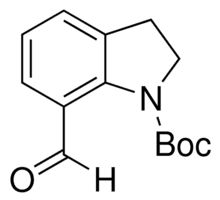
N-Boc-indoline-7-carboxaldehyde
N-Boc-indoline-7-carboxaldehyde (CAS: 174539-67-4), with the molecular formula C14H17NO3 and a molecular weight of 247.29 g/mol, is a key organic building block. This compound functions as a useful bi-functional starter molecule, particularly in the synthesis of indoline derivatives and in the field of natural product chemistry. Its aldehyde and protected amine functionalities allow for diverse chemical transformations.
- IUPAC
- 1-(tert-Butoxycarbonyl)indoline-7-carboxaldehyde
Indoline Chemistry
N-Boc-indoline-7-carboxaldehyde serves as a versatile starting material for the construction of substituted indoline frameworks. The Boc protecting group on the nitrogen allows for selective reactions at the aldehyde moiety before deprotection and further functionalization.
Natural Product Synthesis
The compound's structure, incorporating the indoline core, makes it valuable in the total synthesis of complex natural products that feature this heterocyclic motif. It provides a pre-functionalized indoline unit for incorporation into larger molecular architectures.
Organic Synthesis Building Block
As a bi-functional molecule, it offers synthetic chemists a convenient entry point for introducing both an aldehyde and a protected amine onto an indoline scaffold. This facilitates multi-step synthetic sequences.
| Molecular weight | 247.29 |
|---|---|
| Empirical formula | C14H17NO3 |
| Assay | 97% |
| Application | Useful bi-functional starter in indoline chemistry and natural product chemistry1,2 |
| Melting point | 86-90 °C |

Hazard statements
- H300Fatal if swallowed
- H319Causes serious eye irritation
Precautionary statements
- P264Wash thoroughly after handling
- P301IF SWALLOWED
- P305IF IN EYES
| Protective equipment | Eyeshields, Faceshields, Gloves, type P2 (EN 143) respirator cartridges |
|---|---|
| Transport (UN / ADR) | UN 2811 6.1 / PGIII |
| Water hazard class (WGK, DE) | 3 |
| Hazard codes (EU) | T |
| Risk statements (R) | 25 |
| Safety statements (S) | 45 |
Hazard information is provided for guidance. Always consult the product Safety Data Sheet (SDS), available on request, before handling.
Documentation
Every batch ships with a Certificate of Analysis covering assay, identity and purity; the grade is confirmed against your enquiry. Safety Data Sheets and technical data sheets are available on request.
Supply & logistics
Samples for technical evaluation; bulk MOQ by grade and packaging. In-stock material ships in 7–10 working days, worldwide, with full export documentation.
What is N-Boc-indoline-7-carboxaldehyde used for?
+
N-Boc-indoline-7-carboxaldehyde is primarily used as a bi-functional starter in indoline chemistry and natural product chemistry.
What is the CAS number and molecular formula for N-Boc-indoline-7-carboxaldehyde?
+
The CAS number is 174539-67-4, and the molecular formula is C14H17NO3.
What grade and purity does Tech Serve Solutions supply?
+
Tech Serve Solutions supplies N-Boc-indoline-7-carboxaldehyde with a purity of 97%. This product is suitable for research and synthesis applications; TSS does not represent it as USP, BP, EP, or pharmacopoeia grade.
What are the safety and handling considerations for N-Boc-indoline-7-carboxaldehyde?
+
This compound is classified as Danger with hazards H300 (Fatal if swallowed) and H319 (Causes serious eye irritation). Appropriate personal protective equipment, including eyeshields, faceshields, gloves, and type P2 respirator cartridges, must be used. Handle with extreme caution in a well-ventilated area.
How is N-Boc-indoline-7-carboxaldehyde packed and exported?
+
Products are packed according to international shipping regulations for hazardous materials. N-Boc-indoline-7-carboxaldehyde is shipped under UN 2811, Hazard Class 6.1, Packing Group III.
How can I request a sample or quote for N-Boc-indoline-7-carboxaldehyde?
+
Please contact our sales team via the website or email to request a sample or a quotation for N-Boc-indoline-7-carboxaldehyde.
▶ Related products

4-Amino-2-chloropyridine
C5H5ClN2
Heterocyclic Building Blocks
4-Ethynyl-1-methyl-1H-pyrazole
C6H6N2
Heterocyclic Building Blocks
4-Hydroxyquinoline-3-carboxylic acid ethyl ester
C12H11NO3
Heterocyclic Building Blocks
4-isocyanatopyridine
C6H4N2O
Heterocyclic Building Blocks
5-Chloro-2,8-dimethylquinoline
Heterocyclic Building Blocks

5-Chloro-2-methylene-1,3,3-trimethylindoline
Heterocyclic Building Blocks

5-Chloro-2-thiophenecarbonitrile
Heterocyclic Building Blocks

5-ethynyl-1H-pyrazole
C5H4N2
Heterocyclic Building Blocks