
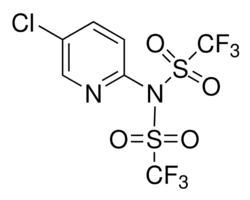
N-(5-Chloro-2-pyridyl)bis(trifluoromethanesulfonimide)
N-(5-Chloro-2-pyridyl)bis(trifluoromethanesulfonimide), CAS 145100-51-2, is a crystalline triflating reagent widely known as Comins' Reagent. With the molecular formula C7H3ClF6N2O4S2 and a molar mass of 392.68 g/mol, it converts ketone enolates and dienolates into the corresponding vinyl (enol) triflates in good yield. Tech Serve Solutions supplies this heterocyclic synthetic reagent at 96% assay as a research-grade building block for organic and medicinal chemistry, exported worldwide to laboratories and process-development teams.
- IUPAC
- 2-[N,N-Bis(trifluoromethylsulfonyl)amino]-5-chloropyridine,N,N-Bis(trifluoromethylsulfonyl)-5-chloro-2-pyridylamine,Comins’ Reagent
- Synonyms
- Comins' Reagent2-[N,N-Bis(trifluoromethylsulfonyl)amino]-5-chloropyridineN,N-Bis(trifluoromethylsulfonyl)-5-chloro-2-pyridylamineN-(5-Chloro-2-pyridyl)bis(trifluoromethanesulfonimide)5-Chloro-N,N-bis(trifluoromethanesulfonyl)pyridin-2-amine
Vinyl triflate formation
Reacts with ketone enolates and dienolates to deliver the corresponding vinyl (enol) triflates in good yield. These triflates serve as versatile electrophiles for subsequent transformations.
Cross-coupling precursor synthesis
The enol triflates generated with this reagent are common partners in palladium-catalysed cross-coupling reactions, enabling carbon-carbon and carbon-heteroatom bond construction.
Heterocyclic and building-block chemistry
Used as a pyridine-based synthetic reagent for installing the trifluoromethanesulfonyl (triflyl) group during multistep routes. It supports the assembly of complex molecular scaffolds.
Medicinal and process chemistry research
Applied in discovery and process-development laboratories where regioselective triflation is required. Its crystalline character and defined reactivity make it convenient for reproducible bench-scale work.
| Molecular weight | 392.68 |
|---|---|
| Empirical formula | C7H3ClF6N2O4S2 |
| Assay | 96% |
| Storage temperature | 2-8°C |
| Application | Provides good yields of vinyl triflates from the corresponding ketone enolates or dienolates.1,2,3 |
| Melting point | 45-47 °C(lit.) |

Hazard statements
- H315Causes skin irritation
- H319Causes serious eye irritation
- H335May cause respiratory irritation
Precautionary statements
- P261Avoid breathing dust, fume, gas or vapours
- P305IF IN EYES
| Protective equipment | dust mask type N95 (US), Eyeshields, Gloves |
|---|---|
| Water hazard class (WGK, DE) | 3 |
| Hazard codes (EU) | Xi |
| Risk statements (R) | 36/37/38 |
| Safety statements (S) | 26-36 |
Hazard information is provided for guidance. Always consult the product Safety Data Sheet (SDS), available on request, before handling.
Documentation
Every batch ships with a Certificate of Analysis covering assay, identity and purity; the grade is confirmed against your enquiry. Safety Data Sheets and technical data sheets are available on request.
Supply & logistics
Samples for technical evaluation; bulk MOQ by grade and packaging. In-stock material ships in 7–10 working days, worldwide, with full export documentation.
What is N-(5-Chloro-2-pyridyl)bis(trifluoromethanesulfonimide) used for?
+
It is a triflating reagent, commonly called Comins' Reagent, used to convert ketone enolates and dienolates into the corresponding vinyl (enol) triflates in good yield. These triflates are valuable intermediates and electrophiles in organic synthesis, including palladium-catalysed cross-coupling.
What is the CAS number and molecular formula of N-(5-Chloro-2-pyridyl)bis(trifluoromethanesulfonimide)?
+
The CAS number is 145100-51-2 and the molecular formula is C7H3ClF6N2O4S2, with a molecular weight of 392.68 g/mol. Its MDL number is MFCD00191833 and its Beilstein registry number is 5833971.
What grade and purity does Tech Serve Solutions supply?
+
Tech Serve Solutions supplies this product as a research-grade synthetic reagent with a typical assay of 96%. We do not represent it as USP, BP or EP pharmacopoeial grade. A certificate of analysis is provided with each batch, and recommended storage is at 2-8 C.
What are the safety and handling precautions for this reagent?
+
It carries GHS pictogram GHS07 with the signal word Warning. The hazard statements are H315 (causes skin irritation), H319 (causes serious eye irritation) and H335 (may cause respiratory irritation). Use gloves, eye protection and an N95-type dust mask, avoid dust generation, and consult the Safety Data Sheet before handling.
How is N-(5-Chloro-2-pyridyl)bis(trifluoromethanesulfonimide) packed, shipped and exported?
+
It is packed in tightly sealed, moisture-protected containers sized to order, from gram quantities to bulk, with full labelling and documentation. As a crystalline solid (melting point 45-47 C) it is shipped under controlled conditions, and Tech Serve Solutions arranges compliant export to laboratories and manufacturers worldwide.
Is this a controlled or scheduled substance?
+
The supplied data does not indicate any narcotic, psychotropic or drug-precursor control for this compound. It is classified as a water hazard class WGK 3 substance in Germany, so handling and disposal should follow local environmental regulations.
How do I request a sample or quote?
+
Contact Tech Serve Solutions with your required quantity, purity and destination, and our team will respond with availability, lead time and export documentation. Samples and bulk quantities can be arranged for qualified laboratory and industrial customers.
▶ Related products

4-Amino-2-chloropyridine
C5H5ClN2
Heterocyclic Building Blocks
4-Ethynyl-1-methyl-1H-pyrazole
C6H6N2
Heterocyclic Building Blocks
4-Hydroxyquinoline-3-carboxylic acid ethyl ester
C12H11NO3
Heterocyclic Building Blocks
4-isocyanatopyridine
C6H4N2O
Heterocyclic Building Blocks
5-Chloro-2,8-dimethylquinoline
Heterocyclic Building Blocks

5-Chloro-2-methylene-1,3,3-trimethylindoline
Heterocyclic Building Blocks

5-Chloro-2-thiophenecarbonitrile
Heterocyclic Building Blocks

5-ethynyl-1H-pyrazole
C5H4N2
Heterocyclic Building Blocks▶ Explore more

Bis(cyclopentadienyl)cobalt(III) hexafluorophosphate
C10H10CoF6P
Catalysis & Inorganic
1-(4-Chlorophenyl)biguanide hydrochloride
ClC6H4NHC(NH)NHC(NH)NH2 · HCl
Chemical Synthesis
Bis(cyclopentadienyl)dimethylzirconium(IV)
Catalysis & Inorganic

1-(4-Chlorophenyl)ethanol
ClC6H4CH(CH3)OH
Chemical Synthesis