
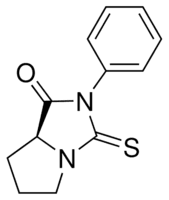
PTH-L-proline
PTH-L-proline (CAS: 29635-99-2, C12H12N2OS) is a key reagent in peptide and protein chemistry. With a molecular weight of 232.30, it is primarily employed in protein sequencing, structural analysis, and proteomics research. This compound facilitates the step-wise degradation of proteins and peptides, enabling the identification of amino acid sequences. Tech Serve Solutions supplies PTH-L-proline for research and development applications.
Protein Sequencing
PTH-L-proline is used as a reagent in Edman degradation for the sequential analysis of amino acids in peptides and proteins. This method allows for the determination of the N-terminal sequence of polypeptide chains.
Peptide Synthesis
It can serve as a building block or intermediate in the synthesis of specific peptides. Its incorporation into peptide chains can be important for structural or functional studies.
Proteomics Research
In proteomics, PTH-L-proline aids in the characterisation of proteins, contributing to the understanding of protein function and interactions within biological systems.
Protein Structural Analysis
The compound plays a role in methods aimed at elucidating the three-dimensional structure of proteins, providing insights into their biological activity.
| Molecular weight | 232.30 |
|---|---|
| Empirical formula | C12H12N2OS |
| Storage temperature | −20°C |
| Protective equipment | Eyeshields, Gloves, type N95 (US), type P1 (EN143) respirator filter |
|---|---|
| Water hazard class (WGK, DE) | 3 |
Hazard information is provided for guidance. Always consult the product Safety Data Sheet (SDS), available on request, before handling.
Documentation
Every batch ships with a Certificate of Analysis covering assay, identity and purity; the grade is confirmed against your enquiry. Safety Data Sheets and technical data sheets are available on request.
Supply & logistics
Samples for technical evaluation; bulk MOQ by grade and packaging. In-stock material ships in 7–10 working days, worldwide, with full export documentation.
What is PTH-L-proline used for?
+
PTH-L-proline (CAS: 29635-99-2) is primarily used as a reagent in protein sequencing via Edman degradation, as well as in peptide synthesis, proteomics, and protein structural analysis.
What is the CAS number and molecular formula of PTH-L-proline?
+
The CAS number for PTH-L-proline is 29635-99-2, and its molecular formula is C12H12N2OS.
What grade and purity does Tech Serve Solutions supply?
+
Tech Serve Solutions supplies PTH-L-proline for research purposes. The specific grade and purity are available upon request and detailed on the Certificate of Analysis. We do not represent this product as USP, BP, or EP grade.
How should PTH-L-proline be handled and stored?
+
PTH-L-proline should be stored at -20°C. When handling, use appropriate personal protective equipment, including eyeshields and gloves. A respirator filter (type N95 or P1) may be necessary depending on the handling conditions.
Is this chemical a controlled substance?
+
The provided data does not indicate that PTH-L-proline is a controlled substance.
How can I request a sample or quote for PTH-L-proline?
+
To request a sample or a quote for PTH-L-proline, please contact our sales department through the website or by calling us directly.
How is PTH-L-proline shipped?
+
PTH-L-proline is carefully packed and exported in compliance with all relevant shipping regulations for chemical substances.
▶ Related products

Acrylamide
Molecular Biology

Agarose
Molecular Biology

N,N′-Methylenebisacrylamide
Molecular Biology

Zinc sulfate solution
Molecular Biology

(±)-Jasmonic acid
C12H18O3
Molecular Biology
(−)-cis,trans-Abscisic acid
Molecular Biology

(2,4-Dichlorophenoxy)acetic acid sodium salt monohydrate
Molecular Biology

(2R,5R)-Bis(hydroxymethyl)-(3R,4R)-dihydroxypyrrolidine
Molecular Biology
▶ Explore more

Bis(cyclopentadienyl)cobalt(III) hexafluorophosphate
C10H10CoF6P
Catalysis & Inorganic
1-(4-Chlorophenyl)biguanide hydrochloride
ClC6H4NHC(NH)NHC(NH)NH2 · HCl
Chemical Synthesis
Bis(cyclopentadienyl)dimethylzirconium(IV)
Catalysis & Inorganic

1-(4-Chlorophenyl)ethanol
ClC6H4CH(CH3)OH
Chemical Synthesis