
n-Butyllithium solution
n-Butyllithium solution (CAS: 109-72-8, CH3(CH2)3Li, MW: 64.06) is a highly reactive organometallic compound widely employed as a strong base and nucleophile in organic synthesis. It is crucial for deprotonation reactions, enabling the formation of carbanions for subsequent C-C bond formation. Available as a 2.5 M solution in toluene, this reagent is vital in the pharmaceutical and fine chemical industries for constructing complex molecular architectures.
- IUPAC
- n-BuLi,Butyl lithium,Butyllithium solution,Lithium-1-butanide
- Synonyms
- n-BuLiButyl lithiumButyllithium solutionLithium-1-butanide
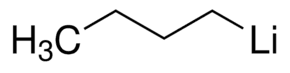
Organometallic Reagent
n-Butyllithium is a potent organometallic reagent used for various synthetic transformations. Its strong basicity allows for efficient deprotonation of weakly acidic protons, facilitating the generation of nucleophilic species.
Polymerization Initiator
In polymer science, n-butyllithium acts as an initiator for anionic polymerization, enabling the synthesis of well-defined polymers with controlled molecular weights and architectures.
Metalation Agent
It is extensively used in directed ortho-metalation (DoM) reactions, where it regioselectively deprotonates aromatic rings, allowing for the introduction of various electrophiles.
Deprotonation Reactions
As a strong base, it is ideal for deprotonating terminal alkynes, active methylene compounds, and heterocycles, paving the way for numerous carbon-carbon bond-forming reactions.
| Molecular weight | 64.06 |
|---|---|
| Linear formula | CH3(CH2)3Li |
| Boiling point | 80 °C |
| Density | 0.83 g/mL at 20 °C |
| Concentration | 2.5 M in toluene |
| Storage temperature | 2-8°C |


Hazard statements
- H225Highly flammable liquid and vapour
- H250Catches fire spontaneously if exposed to air
- H261In contact with water releases flammable gas
- H304May be fatal if swallowed and enters airways
- H314Causes severe skin burns and eye damage
- H336May cause drowsiness or dizziness
- H361D
- H373May cause damage to organs through prolonged exposure
Precautionary statements
- P210Keep away from heat, sparks and open flames. No smoking
- P222Do not allow contact with air
- P231Handle under inert gas
- P261Avoid breathing dust, fume, gas or vapours
- P280Wear protective gloves, clothing and eye/face protection
- P422
| Flash point | -6 °C / 21.2 °F |
|---|---|
| Transport (UN / ADR) | UN 3394 4.2/PG 1 |
| Water hazard class (WGK, DE) | 2 |
| Hazard codes (EU) | F,C |
| Risk statements (R) | 63-11-14/15-34-48/20-65-67 |
| Safety statements (S) | 16-26-36/37/39-43-45-62 |
| Supplemental hazards | Reacts violently with water. |
Hazard information is provided for guidance. Always consult the product Safety Data Sheet (SDS), available on request, before handling.
| Shelf Life | (limited shelf life) |
|---|
Documentation
Every batch ships with a Certificate of Analysis covering assay, identity and purity; the grade is confirmed against your enquiry. Safety Data Sheets and technical data sheets are available on request.
Supply & logistics
Samples for technical evaluation; bulk MOQ by grade and packaging. In-stock material ships in 7–10 working days, worldwide, with full export documentation.
What is n-Butyllithium solution primarily used for?
+
n-Butyllithium solution is primarily used as a strong base and nucleophile in organic synthesis for deprotonation reactions and the formation of carbanions, enabling carbon-carbon bond formation.
What are the CAS number and formula for n-Butyllithium solution?
+
The CAS number for n-Butyllithium solution is 109-72-8, and its chemical formula is CH3(CH2)3Li.
What grade and purity does Tech Serve Solutions supply?
+
Tech Serve Solutions supplies n-Butyllithium solution as a 2.5 M solution in toluene. TSS does not represent this product as USP/BP/EP grade; it is suitable for research and industrial synthesis.
How should n-Butyllithium solution be handled safely?
+
n-Butyllithium solution is highly flammable, pyrophoric (reacts violently with air), and corrosive. It reacts violently with water. Handle under an inert atmosphere (e.g., nitrogen or argon) in a well-ventilated area, wearing appropriate personal protective equipment including flame-resistant clothing, gloves, and eye protection. Never allow contact with water or moist air.
Is n-Butyllithium solution packed and shipped internationally?
+
Yes, Tech Serve Solutions exports n-Butyllithium solution globally. It is shipped in specialised containers suitable for hazardous materials, adhering to all international transport regulations for flammable and pyrophoric substances.
How can I request a sample or a quote for n-Butyllithium solution?
+
To request a sample or a quote, please contact our sales department through the website or call us directly. Please specify the quantity and any particular requirements.
▶ Related products

5-Sulfosalicylic acid dihydrate
HO3SC6H3-2-(OH)CO2H 2H2O
Acids & Bases
Calcium hydroxide
Ca(OH)2
Acids & Bases
Acetic acid-12C2
12CH312CO2H
Acids & Bases
Acetic acid-13C2
13CH313CO2H
Acids & Bases
Acetic acid-13C2,d4
Acids & Bases

Acetic acid-17O2
CH3C17O2H
Acids & Bases
Acetic acid-18O2
CH3C18O2H
Acids & Bases
Acetic acid-2,2,2-d3
2-d3
Acids & Bases▶ Explore more

Bis(cyclopentadienyl)cobalt(III) hexafluorophosphate
C10H10CoF6P
Catalysis & Inorganic
1-(4-Chlorophenyl)biguanide hydrochloride
ClC6H4NHC(NH)NHC(NH)NH2 · HCl
Chemical Synthesis
Bis(cyclopentadienyl)dimethylzirconium(IV)
Catalysis & Inorganic

1-(4-Chlorophenyl)ethanol
ClC6H4CH(CH3)OH
Chemical Synthesis