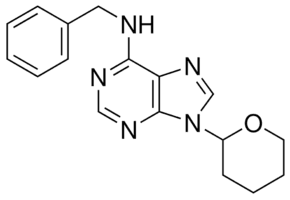
N-Benzyl-9-(2-tetrahydropyranyl)adenine
N-Benzyl-9-(2-tetrahydropyranyl)adenine (CAS: 2312-73-4; Formula: C17H19N5O; MW: 309.37) is a synthetic cytokinin analogue. It functions as a plant growth regulator, widely utilised in plant biotechnology and molecular biology applications. This compound is instrumental in plant cell culture, promoting cell division and differentiation. Tech Serve Solutions supplies this research-grade chemical, tested for plant cell culture suitability.
- IUPAC
- 6-Benzylamino-9-(2-tetrahydropyranyl)-9H-purine,BPA
Plant Tissue Culture
N-Benzyl-9-(2-tetrahydropyranyl)adenine serves as a plant growth regulator in tissue culture media. It promotes cell division and differentiation, aiding in plant regeneration and propagation.
Molecular Biology Research
This compound is employed in molecular biology studies involving plant genetics and development. Its activity as a cytokinin analogue allows for investigations into plant hormone signalling pathways.
Plant Biotechnology
As a tool in plant biotechnology, it supports research aimed at improving crop yields and plant resilience. Its application in cell culture facilitates the study of plant cellular processes.
| Molecular weight | 309.37 |
|---|---|
| Empirical formula | C17H19N5O |
| Storage temperature | −20°C |
| Suitability | plant cell culture tested |

Hazard statements
- H302Harmful if swallowed
| Protective equipment | dust mask type N95 (US), Eyeshields, Gloves |
|---|---|
| Water hazard class (WGK, DE) | 3 |
| Hazard codes (EU) | Xn |
| Risk statements (R) | 22 |
| Safety statements (S) | 26-36 |
Hazard information is provided for guidance. Always consult the product Safety Data Sheet (SDS), available on request, before handling.
Documentation
Every batch ships with a Certificate of Analysis covering assay, identity and purity; the grade is confirmed against your enquiry. Safety Data Sheets and technical data sheets are available on request.
Supply & logistics
Samples for technical evaluation; bulk MOQ by grade and packaging. In-stock material ships in 7–10 working days, worldwide, with full export documentation.
What is N-Benzyl-9-(2-tetrahydropyranyl)adenine used for?
+
N-Benzyl-9-(2-tetrahydropyranyl)adenine is used as a plant growth regulator, primarily in plant tissue culture, molecular biology, and plant biotechnology research.
What are the CAS number and chemical formula for N-Benzyl-9-(2-tetrahydropyranyl)adenine?
+
The CAS number is 2312-73-4, and the chemical formula is C17H19N5O.
What grade and purity does Tech Serve Solutions supply?
+
Tech Serve Solutions supplies N-Benzyl-9-(2-tetrahydropyranyl)adenine tested for plant cell culture suitability. As this is a research-grade chemical, TSS does not represent it as USP, BP, or EP grade.
How should N-Benzyl-9-(2-tetrahydropyranyl)adenine be handled safely?
+
N-Benzyl-9-(2-tetrahydropyranyl)adenine is classified as harmful if swallowed (H302). When handling, use a dust mask type N95 (US), eyeshields, and gloves. Ensure adequate ventilation and avoid dust formation.
How is this chemical packed and shipped?
+
This chemical is typically packed in secure containers suitable for laboratory reagents and is exported globally by Tech Serve Solutions, adhering to international shipping regulations.
How can I request a sample or quote for N-Benzyl-9-(2-tetrahydropyranyl)adenine?
+
Please contact our sales team via the website or email to request a sample or obtain a quotation for N-Benzyl-9-(2-tetrahydropyranyl)adenine.
▶ Related products

Acrylamide
Molecular Biology

Agarose
Molecular Biology

N,N′-Methylenebisacrylamide
Molecular Biology

Zinc sulfate solution
Molecular Biology

(±)-Jasmonic acid
C12H18O3
Molecular Biology
(−)-cis,trans-Abscisic acid
Molecular Biology

(2,4-Dichlorophenoxy)acetic acid sodium salt monohydrate
Molecular Biology

(2R,5R)-Bis(hydroxymethyl)-(3R,4R)-dihydroxypyrrolidine
Molecular Biology