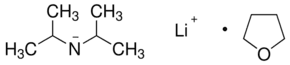
Lithium diisopropylamide mono(tetrahydrofuran) solution
Lithium diisopropylamide mono(tetrahydrofuran) solution (CAS: 123333-84-6), with a molecular weight of 179.23 g/mol, is a potent, non-nucleophilic strong base. It is widely employed in organic synthesis as a deprotonating agent, particularly for generating enolates from ketones and esters. The solution, supplied at 1.5 M in cyclohexane and stabilized with tetrahydrofuran, is ideal for applications requiring precise control over reactivity and selectivity in complex molecular transformations.
Enolate Formation
Lithium diisopropylamide (LDA) is a preferred reagent for regioselective deprotonation of carbonyl compounds, facilitating the formation of kinetically controlled enolates. This is crucial for directed aldol reactions and alkylations.
Deprotonation of Weakly Acidic Protons
This strong base can effectively remove protons from various carbon acids, including terminal alkynes and certain activated methylene groups. Its steric bulk minimises unwanted nucleophilic attack.
Metal-Halogen Exchange
LDA can participate in metal-halogen exchange reactions with organohalides, generating organolithium intermediates. These can then be used in subsequent synthetic steps.
Generation of Carbanions
It serves as a key reagent for generating carbanions, which are versatile nucleophiles in a wide range of carbon-carbon bond-forming reactions in advanced organic synthesis.
| Molecular weight | 179.23 |
|---|---|
| Empirical formula | C10H22LiNO |
| Density | 0.816 g/mL at 25 °C |
| Concentration | 1.5 M in cyclohexane |
| Vapour density | >1 (vs air) |
| Storage temperature | 2-8°C |


Hazard statements
- H225Highly flammable liquid and vapour
- H304May be fatal if swallowed and enters airways
- H314Causes severe skin burns and eye damage
- H332Harmful if inhaled
- H336May cause drowsiness or dizziness
- H410Very toxic to aquatic life with long-lasting effects
Precautionary statements
- P210Keep away from heat, sparks and open flames. No smoking
- P261Avoid breathing dust, fume, gas or vapours
- P273Avoid release to the environment
- P280Wear protective gloves, clothing and eye/face protection
- P301IF SWALLOWED
- P305IF IN EYES
| Protective equipment | Faceshields, full-face respirator (US), Gloves, Goggles, multi-purpose combination respirator cartridge (US), type ABEK (EN14387) respirator filter |
|---|---|
| Flash point | -18 °C / -.4 °F |
| Transport (UN / ADR) | UN 2924 3/PG 2 |
| Water hazard class (WGK, DE) | 3 |
| Hazard codes (EU) | F,C,N |
| Risk statements (R) | 11-20-34-50/53-65 |
| Safety statements (S) | 16-26-36/37/39-45-61-62 |
Hazard information is provided for guidance. Always consult the product Safety Data Sheet (SDS), available on request, before handling.
Documentation
Every batch ships with a Certificate of Analysis covering assay, identity and purity; the grade is confirmed against your enquiry. Safety Data Sheets and technical data sheets are available on request.
Supply & logistics
Samples for technical evaluation; bulk MOQ by grade and packaging. In-stock material ships in 7–10 working days, worldwide, with full export documentation.
What is Lithium diisopropylamide mono(tetrahydrofuran) solution used for?
+
Lithium diisopropylamide mono(tetrahydrofuran) solution (CAS: 123333-84-6) is primarily used as a strong, non-nucleophilic base in organic synthesis, particularly for enolate formation, deprotonation of weakly acidic protons, metal-halogen exchange, and generation of carbanions.
What are the CAS number and formula for Lithium diisopropylamide mono(tetrahydrofuran) solution?
+
The CAS number is 123333-84-6 and the empirical formula (Hill notation) is C10H22LiNO.
What grade and purity does Tech Serve Solutions supply?
+
Tech Serve Solutions supplies Lithium diisopropylamide mono(tetrahydrofuran) solution at a concentration of 1.5 M in cyclohexane. We do not represent this product as USP, BP, EP, or any other pharmacopoeia grade.
How should Lithium diisopropylamide mono(tetrahydrofuran) solution be handled safely?
+
This product is a Danger material (GHS02, GHS05, GHS07, GHS08, GHS09) and is highly flammable (H225) and corrosive (H314). It is harmful if inhaled (H332) and can cause drowsiness or dizziness (H336). It is also toxic to aquatic life with long-lasting effects (H410). Always use appropriate personal protective equipment, including face shields, gloves, goggles, and a suitable respirator, in a well-ventilated area. Store at 2-8°C.
How is this chemical packed and shipped?
+
Lithium diisopropylamide mono(tetrahydrofuran) solution is typically packed in compliance with transport regulations for hazardous materials (UN 2924 3/PG 2). We export globally, adhering to all necessary shipping and customs requirements.
How can I request a sample or quote?
+
To request a sample or a quote for Lithium diisopropylamide mono(tetrahydrofuran) solution, please visit our website or contact our sales department directly with your specific requirements.
▶ Related products

5-Sulfosalicylic acid dihydrate
HO3SC6H3-2-(OH)CO2H 2H2O
Acids & Bases
Calcium hydroxide
Ca(OH)2
Acids & Bases
Acetic acid-12C2
12CH312CO2H
Acids & Bases
Acetic acid-13C2
13CH313CO2H
Acids & Bases
Acetic acid-13C2,d4
Acids & Bases

Acetic acid-17O2
CH3C17O2H
Acids & Bases
Acetic acid-18O2
CH3C18O2H
Acids & Bases
Acetic acid-2,2,2-d3
2-d3
Acids & Bases