
Jone′s reagent
Jone's reagent (CAS: 65272-70-0) is a potent oxidizing agent comprising chromium trioxide in sulfuric acid. It serves as a key reactant in various organic synthesis applications, notably the oxidation of oximes to carbonyl compounds and benzoins to benzils. Supplied by Tech Serve Solutions, this inorganic acid is crucial for laboratories undertaking complex chemical transformations. Its precise composition and reactivity make it an indispensable tool for synthetic chemists.
- IUPAC
- Chromium trioxide solution in sulfuric acid,Sulfuric acid-chromium trioxide mixture
- Synonyms
- Chromium trioxide solution in sulfuric acidSulfuric acid-chromium trioxide mixture
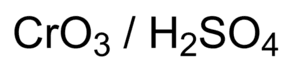
Oxidation of Oximes to Carbonyl Compounds
Jone's reagent is employed as a reliable oxidant for converting oximes into their corresponding carbonyl compounds. This transformation is a fundamental step in many synthetic pathways.
Oxidation of Benzoins to Benzils
This reagent facilitates the oxidation of benzoins to benzils, a valuable reaction for synthesizing diketones used in various organic chemistry research and development projects.
Specialised Oxidising Agent
Due to its strong oxidative properties, Jone's reagent is utilised in specific oxidation reactions where other oxidants may be less effective or suitable.
| Assay | ~2% CrO3 basis |
|---|---|
| Density | 1.298 g/mL at 25 °C |
| Application | Reactant for:• Oxidation of oximes to carbonyl compounds1• Oxidation of benzoins to benzils2 |


Hazard statements
- H314Causes severe skin burns and eye damage
- H317May cause an allergic skin reaction
- H331Toxic if inhaled
- H334May cause allergy or asthma symptoms if inhaled
- H340May cause genetic defects
- H350May cause cancer
- H360FD
- H373May cause damage to organs through prolonged exposure
- H411Toxic to aquatic life with long-lasting effects
Precautionary statements
- P201Obtain special instructions before use
- P261Avoid breathing dust, fume, gas or vapours
- P273Avoid release to the environment
- P280Wear protective gloves, clothing and eye/face protection
- P305IF IN EYES
- P310Immediately call a POISON CENTER or doctor
| Transport (UN / ADR) | UN 2240 8 / PGI |
|---|---|
| Water hazard class (WGK, DE) | 3 |
| Hazard codes (EU) | T,N |
| Risk statements (R) | 45-46-60-61-23-35-42/43-48/20-51/53 |
| Safety statements (S) | 53-23-26-36/37/39-45-61 |
Hazard information is provided for guidance. Always consult the product Safety Data Sheet (SDS), available on request, before handling.
Documentation
Every batch ships with a Certificate of Analysis covering assay, identity and purity; the grade is confirmed against your enquiry. Safety Data Sheets and technical data sheets are available on request.
Supply & logistics
Samples for technical evaluation; bulk MOQ by grade and packaging. In-stock material ships in 7–10 working days, worldwide, with full export documentation.
What is Jone's reagent used for?
+
Jone's reagent is primarily used as a reactant for the oxidation of oximes to carbonyl compounds and the oxidation of benzoins to benzils in organic synthesis.
What are the CAS number and formula for Jone's reagent?
+
The CAS number for Jone's reagent is 65272-70-0. The chemical formula is not provided in the product data.
What grade and purity does Tech Serve Solutions supply?
+
Tech Serve Solutions supplies Jone's reagent with an assay of approximately 2% CrO3 basis. This product is not represented as USP, BP, EP, or other pharmacopoeial grades.
How should Jone's reagent be handled safely?
+
Jone's reagent is a Danger material, causing severe skin burns and eye damage (H314). It is toxic if inhaled (H331), may cause allergy or asthma symptoms or breathing difficulties if inhaled (H334), and is suspected of causing genetic defects (H340), cancer (H350), and damaging fertility or the unborn child (H360FD). Handle with extreme caution in a well-ventilated area, using appropriate personal protective equipment, and avoid inhalation and contact. Dispose of contents/container in accordance with local regulations.
Is Jone's reagent a controlled substance?
+
The provided data does not indicate that Jone's reagent is a controlled substance.
How is Jone's reagent packed and shipped?
+
Jone's reagent is shipped as UN 2240, Hazard Class 8, Packing Group I. Specific packing details are not provided but will adhere to international shipping regulations for hazardous materials.
How can I request a sample or quote for Jone's reagent?
+
To request a sample or a quote for Jone's reagent, please contact the Tech Serve Solutions sales team through our official website or listed contact details.
▶ Related products

5-Sulfosalicylic acid dihydrate
HO3SC6H3-2-(OH)CO2H 2H2O
Acids & Bases
Calcium hydroxide
Ca(OH)2
Acids & Bases
Acetic acid-12C2
12CH312CO2H
Acids & Bases
Acetic acid-13C2
13CH313CO2H
Acids & Bases
Acetic acid-13C2,d4
Acids & Bases

Acetic acid-17O2
CH3C17O2H
Acids & Bases
Acetic acid-18O2
CH3C18O2H
Acids & Bases
Acetic acid-2,2,2-d3
2-d3
Acids & Bases▶ Explore more

Bis(cyclopentadienyl)cobalt(III) hexafluorophosphate
C10H10CoF6P
Catalysis & Inorganic
1-(4-Chlorophenyl)biguanide hydrochloride
ClC6H4NHC(NH)NHC(NH)NH2 · HCl
Chemical Synthesis
Bis(cyclopentadienyl)dimethylzirconium(IV)
Catalysis & Inorganic

1-(4-Chlorophenyl)ethanol
ClC6H4CH(CH3)OH
Chemical Synthesis