Boron trifluoride dihydrate
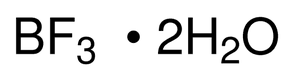
Boron trifluoride dihydrate (CAS: 13319-75-0, BF3 · 2H2O) is a significant chemical compound with a molecular weight of 103.84 g/mol. Supplied by Tech Serve Solutions with a 96% assay, it functions as a Lewis acid and serves as a valuable reagent in various chemical synthesis processes, particularly in catalysis and inorganic chemistry. Its applications span diverse research and industrial fields requiring precise chemical transformations.
Lewis Acid Catalysis
Boron trifluoride dihydrate acts as a strong Lewis acid catalyst, promoting a variety of organic reactions. It is commonly employed in Friedel-Crafts acylations and alkylations, polymerisation, and isomerisation processes.
Chemical Synthesis Reagent
This compound is a versatile reagent in the synthesis of various organic and inorganic compounds. Its ability to coordinate with electron-donating species makes it useful in reactions requiring electrophilic activation.
Inorganic Chemistry
In inorganic chemistry, Boron trifluoride dihydrate is utilised in the preparation of boron-containing compounds and in studies of coordination chemistry. It can serve as a source of the BF3 moiety in aqueous or protic environments.
Analytical Chemistry
It can be applied in certain analytical procedures, though its strong reactivity requires careful handling and specific reaction conditions. Its use may be relevant in derivatisation reactions for chromatographic analysis.
| Molecular weight | 103.84 |
|---|---|
| Linear formula | BF3 · 2H2O |
| Assay | 96% |
| Density | 1.636 g/mL at 25 °C(lit.) |
| Refractive index | n20/D 1.316(lit.) |


Hazard statements
- H314Causes severe skin burns and eye damage
- H330Fatal if inhaled
Precautionary statements
- P280Wear protective gloves, clothing and eye/face protection
- P305IF IN EYES
- P310Immediately call a POISON CENTER or doctor
| Protective equipment | Faceshields, full-face respirator (US), Gloves, Goggles, multi-purpose combination respirator cartridge (US), type ABEK (EN14387) respirator filter |
|---|---|
| Transport (UN / ADR) | UN 2851 8 / PGII |
| Water hazard class (WGK, DE) | 3 |
| Hazard codes (EU) | T+,C |
| Risk statements (R) | 14-26-35 |
| Safety statements (S) | 9-26-28-36/37/39-45 |
Hazard information is provided for guidance. Always consult the product Safety Data Sheet (SDS), available on request, before handling.
Documentation
Every batch ships with a Certificate of Analysis covering assay, identity and purity; the grade is confirmed against your enquiry. Safety Data Sheets and technical data sheets are available on request.
Supply & logistics
Samples for technical evaluation; bulk MOQ by grade and packaging. In-stock material ships in 7–10 working days, worldwide, with full export documentation.
What is Boron trifluoride dihydrate used for?
+
Boron trifluoride dihydrate is primarily used as a Lewis acid catalyst and a reagent in chemical synthesis, particularly in organic reactions, catalysis, and inorganic chemistry.
What are the CAS number and formula for Boron trifluoride dihydrate?
+
The CAS number for Boron trifluoride dihydrate is 13319-75-0, and its chemical formula is BF3 · 2H2O.
What grade and purity does Tech Serve Solutions supply?
+
Tech Serve Solutions supplies Boron trifluoride dihydrate with an assay of 96%. This is typically considered a technical or research grade, and TSS does not represent it as USP, BP, or EP grade.
How should Boron trifluoride dihydrate be handled safely?
+
Boron trifluoride dihydrate is a dangerous substance that causes severe skin burns and eye damage (H314) and is fatal if inhaled (H330). Always wear appropriate personal protective equipment, including a full-face respirator, chemical-resistant gloves, and goggles. Ensure adequate ventilation and handle only in a well-ventilated area or fume hood.
Is Boron trifluoride dihydrate a controlled substance?
+
Based on the provided data, Boron trifluoride dihydrate is not listed as a controlled substance under typical chemical regulations. However, users should always verify local regulations.
How is Boron trifluoride dihydrate packed, shipped, and exported?
+
Boron trifluoride dihydrate is typically packed in accordance with UN 2851, Class 8, Packing Group II regulations for hazardous materials. TSS ensures compliance with international shipping and export regulations for dangerous goods.
How can I request a sample or quote for Boron trifluoride dihydrate?
+
To request a sample or a quote for Boron trifluoride dihydrate, please contact our sales department through the TSS website or by calling our customer service line.
▶ Related products

5-Sulfosalicylic acid dihydrate
HO3SC6H3-2-(OH)CO2H 2H2O
Acids & Bases
Calcium hydroxide
Ca(OH)2
Acids & Bases
Acetic acid-12C2
12CH312CO2H
Acids & Bases
Acetic acid-13C2
13CH313CO2H
Acids & Bases
Acetic acid-13C2,d4
Acids & Bases

Acetic acid-17O2
CH3C17O2H
Acids & Bases
Acetic acid-18O2
CH3C18O2H
Acids & Bases
Acetic acid-2,2,2-d3
2-d3
Acids & Bases