
Aluminum chloride hexahydrate
Aluminum chloride hexahydrate (CAS 7784-13-6; AlCl3 · 6H2O; molar mass 241.43 g/mol) is the hydrated form of aluminium chloride, supplied as a white to pale-yellow crystalline solid that is freely soluble in water. Unlike the anhydrous salt, the hexahydrate is a mild source of aluminium ions rather than a strong Lewis acid. It is widely used as a reagent in chemical synthesis and inorganic chemistry, in water treatment, and as a precursor for astringent and antiperspirant formulations.
- Synonyms
- Aluminum chloride hexahydrateAluminium chloride hexahydrateAluminium trichloride hexahydrateAluminum trichloride hexahydrateAlCl3 · 6H2OAluminium(III) chloride hexahydratehydrated aluminium chloride
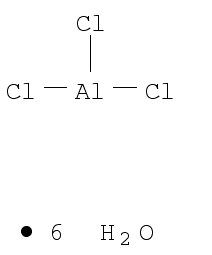
Chemical synthesis and inorganic chemistry
Serves as a soluble source of aluminium ions for laboratory synthesis, salt preparation and coordination chemistry. As a hydrated reagent it is convenient to weigh and dissolve where the moisture-sensitive anhydrous salt is unsuitable.
Water and effluent treatment
Aluminium salts are established coagulants and flocculants for clarifying water and treating wastewater. Dissolved aluminium ions assist in destabilising and settling suspended solids.
Astringent and antiperspirant precursor
Aluminium chloride salts are a well-documented basis for astringent and antiperspirant preparations. The hexahydrate is used as a starting material in such formulation chemistry.
Analytical and research reagent
Used as a general-purpose aluminium reagent in analytical work and method development. The defined assay supports reproducible preparation of standards and test solutions.
| Molecular weight | 241.43 |
|---|---|
| Empirical formula | AlCl3 · 6H2O |
| Assay | 99% |
| Grade | SAJ first grade |
| Vapour pressure | 1 mmHg (100 °C) |
| Suitability | meets EP, BP, USP testing specifications |

Hazard statements
- H315Causes skin irritation
- H319Causes serious eye irritation
- H335May cause respiratory irritation
Precautionary statements
- P261Avoid breathing dust, fume, gas or vapours
- P305IF IN EYES
| Protective equipment | Eyeshields, Faceshields, full-face particle respirator type N100 (US), Gloves, respirator cartridge type N100 (US), type P1 (EN143) respirator filter, type P3 (EN 143) respirator cartridges |
|---|---|
| Water hazard class (WGK, DE) | 3 |
| Hazard codes (EU) | Xi |
| Risk statements (R) | 36/37/38-52 |
| Safety statements (S) | 26 |
Hazard information is provided for guidance. Always consult the product Safety Data Sheet (SDS), available on request, before handling.
| Availability | available only in Japan |
|---|
Documentation
Every batch ships with a Certificate of Analysis covering assay, identity and purity; the grade is confirmed against your enquiry. Safety Data Sheets and technical data sheets are available on request.
Supply & logistics
Samples for technical evaluation; bulk MOQ by grade and packaging. In-stock material ships in 7–10 working days, worldwide, with full export documentation.
What is Aluminum chloride hexahydrate used for?
+
It is used mainly as a soluble aluminium reagent in chemical synthesis and inorganic chemistry, as a coagulant in water and wastewater treatment, and as a precursor in astringent and antiperspirant formulation chemistry. Being the hydrated salt, it provides aluminium ions conveniently in aqueous systems.
What is the CAS number and molecular formula of Aluminum chloride hexahydrate?
+
The CAS number is 7784-13-6 and the EC number is 231-208-1. The empirical formula is AlCl3 · 6H2O, with a molecular weight of 241.43 g/mol.
What grade and purity does Tech Serve Solutions supply?
+
It is supplied at 99% assay (SAJ first grade) and is stated to meet EP, BP and USP testing specifications. Tech Serve Solutions supplies it as a high-purity reagent/technical grade; we can confirm the exact specification and current documentation against your requirement at the time of enquiry.
What are the safety and handling precautions for Aluminum chloride hexahydrate?
+
It is classified under GHS07 with the signal word Warning. The hazard statements are H315 (causes skin irritation), H319 (causes serious eye irritation) and H335 (may cause respiratory irritation). Avoid dust formation, use eye protection and gloves, and consult the Safety Data Sheet before handling. It carries German water-hazard class WGK 3.
How is Aluminum chloride hexahydrate packed, shipped and exported?
+
It is packed in sealed containers appropriate to the order quantity, with labelling and documentation prepared for export. As an experienced exporter, Tech Serve Solutions arranges packing, hazard documentation and shipping to suit your destination and regulatory requirements.
How do I request a sample or quote?
+
Contact Tech Serve Solutions with your required quantity, grade and destination, and we will respond with availability, lead time and documentation. Sample requests can be accommodated subject to specification and quantity.
▶ Related products

5-Sulfosalicylic acid dihydrate
HO3SC6H3-2-(OH)CO2H 2H2O
Acids & Bases
Calcium hydroxide
Ca(OH)2
Acids & Bases
Acetic acid-12C2
12CH312CO2H
Acids & Bases
Acetic acid-13C2
13CH313CO2H
Acids & Bases
Acetic acid-13C2,d4
Acids & Bases

Acetic acid-17O2
CH3C17O2H
Acids & Bases
Acetic acid-18O2
CH3C18O2H
Acids & Bases
Acetic acid-2,2,2-d3
2-d3
Acids & Bases▶ Explore more

Bis(cyclopentadienyl)cobalt(III) hexafluorophosphate
C10H10CoF6P
Catalysis & Inorganic
1-(4-Chlorophenyl)biguanide hydrochloride
ClC6H4NHC(NH)NHC(NH)NH2 · HCl
Chemical Synthesis
Bis(cyclopentadienyl)dimethylzirconium(IV)
Catalysis & Inorganic

1-(4-Chlorophenyl)ethanol
ClC6H4CH(CH3)OH
Chemical Synthesis