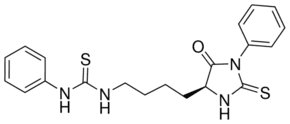
PTH-(ε-phenylthiocarbamyl)lysine
PTH-(ε-phenylthiocarbamyl)lysine (CAS 5657-26-1), with the empirical formula C20H22N4OS2 and a molecular weight of 398.54 g/mol, is a key reagent used in protein sequencing and structural analysis. It plays a crucial role in proteomics by facilitating the identification and characterisation of proteins. This compound is essential for researchers in molecular biology and related fields requiring precise protein analysis.
Protein Sequencing
Utilised in the Edman degradation process for the sequential identification of amino acids in peptides and proteins. It aids in determining the primary structure of proteins.
Protein Structural Analysis
Serves as a reagent in methodologies aimed at understanding the three-dimensional structure of proteins. This aids in correlating structure with function.
Proteomics Research
A critical component in large-scale studies of proteins, their structures, and functions. Essential for identifying and quantifying proteins within complex biological systems.
Molecular Biology Reagent
Employed as a specialised reagent in various molecular biology techniques focused on protein characterisation and analysis.
| Molecular weight | 398.54 |
|---|---|
| Empirical formula | C20H22N4OS2 |
| Storage temperature | −20°C |

Hazard statements
- H301Toxic if swallowed
Precautionary statements
- P301IF SWALLOWED
| Transport (UN / ADR) | UN 2811 6.1 / PGIII |
|---|---|
| Water hazard class (WGK, DE) | 3 |
| Hazard codes (EU) | T |
| Risk statements (R) | 25 |
| Safety statements (S) | 45 |
Hazard information is provided for guidance. Always consult the product Safety Data Sheet (SDS), available on request, before handling.
Documentation
Every batch ships with a Certificate of Analysis covering assay, identity and purity; the grade is confirmed against your enquiry. Safety Data Sheets and technical data sheets are available on request.
Supply & logistics
Samples for technical evaluation; bulk MOQ by grade and packaging. In-stock material ships in 7–10 working days, worldwide, with full export documentation.
What is PTH-(ε-phenylthiocarbamyl)lysine used for?
+
PTH-(ε-phenylthiocarbamyl)lysine is primarily used as a reagent in protein sequencing, protein structural analysis, and broader proteomics research.
What are the CAS number and formula for PTH-(ε-phenylthiocarbamyl)lysine?
+
The CAS number for PTH-(ε-phenylthiocarbamyl)lysine is 5657-26-1, and its empirical formula is C20H22N4OS2.
What grade and purity does Tech Serve Solutions supply?
+
Tech Serve Solutions supplies this chemical for research purposes. Specific purity and grade information is available upon request, and TSS does not represent it as USP, BP, or EP grade.
How should PTH-(ε-phenylthiocarbamyl)lysine be handled safely?
+
This compound is acutely toxic if swallowed (H301) and requires careful handling. Use appropriate personal protective equipment, including gloves, eye protection, and respiratory protection, and handle in a well-ventilated area or fume hood. Ensure immediate medical attention if swallowed (P301 + P310).
How is PTH-(ε-phenylthiocarbamyl)lysine packed and shipped?
+
PTH-(ε-phenylthiocarbamyl)lysine is carefully packed according to international regulations for hazardous materials and exported globally by Tech Serve Solutions.
How can I request a sample or quote for PTH-(ε-phenylthiocarbamyl)lysine?
+
To request a sample or quote, please contact our sales department via the website or direct email, providing your specific requirements and shipping details.
▶ Related products

Acrylamide
Molecular Biology

Agarose
Molecular Biology

N,N′-Methylenebisacrylamide
Molecular Biology

Zinc sulfate solution
Molecular Biology

(±)-Jasmonic acid
C12H18O3
Molecular Biology
(−)-cis,trans-Abscisic acid
Molecular Biology

(2,4-Dichlorophenoxy)acetic acid sodium salt monohydrate
Molecular Biology

(2R,5R)-Bis(hydroxymethyl)-(3R,4R)-dihydroxypyrrolidine
Molecular Biology