N-[3-(Trimethoxysilyl)propyl]aniline
N-[3-(Trimethoxysilyl)propyl]aniline (CAS: 3068-76-6) is an organosilicon compound with the formula C6H5NH(CH2)3Si(OCH3)3 and a molecular weight of 255.39 g/mol. This liquid chemical functions as a versatile intermediate in chemical synthesis and materials science. Its silane functionality allows for surface modification and incorporation into polymer networks, making it valuable in developing advanced materials and in micro/nanoelectronics applications.
- IUPAC
- (3-Anilinopropyl)trimethoxysilane,N-[3-(Trimethoxysilyl)propyl]aniline,Trimethoxy[3-(phenylamino)propyl]silane,[3-(Phenylamino)propyl]trimethoxysilane
- Synonyms
- (3-Anilinopropyl)trimethoxysilaneTrimethoxy[3-(phenylamino)propyl]silane[3-(Phenylamino)propyl]trimethoxysilane
![N-[3-(Trimethoxysilyl)propyl]aniline (C6H5NH(CH2)3Si(OCH3)3) — chemical structure, CAS 3068-76-6; Chemistry, fine chemical supplied by Tech Serve Solutions](/_next/image?url=https%3A%2F%2Fpub-f4d920c906024441a773a96f7098e551.r2.dev%2Fimages%2Fproducts%2F3068-76-6.png&w=3840&q=75)
Surface Modification Agent
This compound can be used to modify surfaces by forming covalent bonds, altering properties such as adhesion, wettability, and compatibility with other materials. It is particularly useful for treating inorganic substrates or nanoparticles.
Silane Coupling Agent
As a trialkoxysilane, it can act as a coupling agent between organic polymers and inorganic fillers or substrates. This enhances the mechanical properties and durability of composite materials.
Materials Science Research
It serves as a building block in the synthesis of novel organosilicon polymers and self-assembled monolayers. Its dual functionality allows for integration into advanced materials and nanotechnology.
Intermediate in Organic Synthesis
The aniline and trimethoxysilyl groups offer distinct reactive sites for further chemical transformations, enabling its use in the synthesis of more complex molecules for various research and industrial applications.
| Molecular weight | 255.39 |
|---|---|
| Linear formula | C6H5NH(CH2)3Si(OCH3)3 |
| Form | liquid |
| Boiling point | 310 °C(lit.) |
| Density | 1.07 g/mL at 25 °C(lit.) |
| Refractive index | n20/D 1.506(lit.) |


Hazard statements
- H314Causes severe skin burns and eye damage
- H317May cause an allergic skin reaction
- H341Suspected of causing genetic defects
- H351Suspected of causing cancer
- H372Causes damage to organs through prolonged exposure
Precautionary statements
- P280Wear protective gloves, clothing and eye/face protection
- P281Use personal protective equipment as required
- P305IF IN EYES
- P310Immediately call a POISON CENTER or doctor
- P314Get medical attention if you feel unwell
| Flash point | 110 °C / 230 °F |
|---|---|
| Transport (UN / ADR) | UN 3267 8 / PGII |
| Water hazard class (WGK, DE) | 1 |
| Hazard codes (EU) | C |
| Risk statements (R) | 34-40-43-48/20/21/22-68 |
| Safety statements (S) | 26-35-36/37/39-45 |
Hazard information is provided for guidance. Always consult the product Safety Data Sheet (SDS), available on request, before handling.
Documentation
Every batch ships with a Certificate of Analysis covering assay, identity and purity; the grade is confirmed against your enquiry. Safety Data Sheets and technical data sheets are available on request.
Supply & logistics
Samples for technical evaluation; bulk MOQ by grade and packaging. In-stock material ships in 7–10 working days, worldwide, with full export documentation.
What is N-[3-(Trimethoxysilyl)propyl]aniline used for?
+
N-[3-(Trimethoxysilyl)propyl]aniline is used in chemical synthesis and materials science, including surface modification, as a silane coupling agent, and in the development of advanced materials and micro/nanoelectronics.
What are the CAS number and formula for N-[3-(Trimethoxysilyl)propyl]aniline?
+
The CAS number is 3068-76-6 and the formula is C6H5NH(CH2)3Si(OCH3)3.
What grade and purity does Tech Serve Solutions supply?
+
Tech Serve Solutions supplies this product as a liquid with a refractive index of n20/D 1.506. TSS does not represent this product as USP/BP/EP or for pharmaceutical, nutraceutical, food, or cosmetic use. Please inquire for specific lot details.
What are the safety considerations for handling N-[3-(Trimethoxysilyl)propyl]aniline?
+
This compound is a Danger hazard, indicated by GHS05, GHS07, and GHS08 symbols. It causes severe skin burns and eye damage (H314), may cause an allergic skin reaction (H317), is suspected of causing genetic defects (H341), and cancer (H351), and may cause damage to organs through prolonged or repeated exposure (H372). Always use appropriate personal protective equipment, including gloves, eye protection, and protective clothing, and work in a well-ventilated area. Refer to the Safety Data Sheet for detailed handling instructions.
How is N-[3-(Trimethoxysilyl)propyl]aniline packaged and shipped?
+
N-[3-(Trimethoxysilyl)propyl]aniline is shipped as a liquid under UN 3267, Hazard Class 8, Packing Group II. Contact us for specific packaging options and export details.
How can I request a sample or quote for N-[3-(Trimethoxysilyl)propyl]aniline?
+
To request a sample or a quotation, please contact our sales team via the website or by phone, providing your specific requirements.
▶ Related products
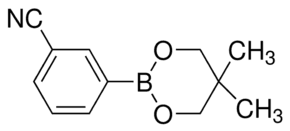
(3-Cyanophenyl)boronic acid, neopentyl glycol ester
Organometallic Reagents
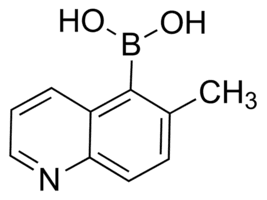
(6-Methyl-5-quinolinyl)boronic acid
C10H10BNO2
Organometallic Reagents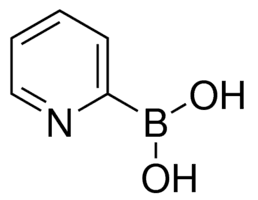
2-Pyridineboronic acid
C5H6BNO2
Organometallic Reagents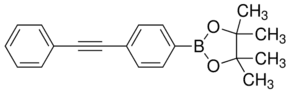
4-(Phenylethynyl)phenylboronic acid pinacol ester
C20H21BO2
Organometallic Reagents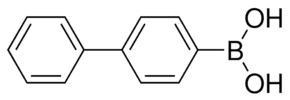
4-Biphenylboronic acid
C6H5C6H4B(OH)2
Organometallic Reagents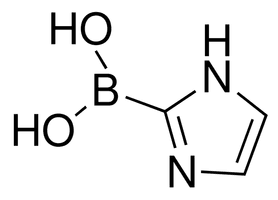
Imidazole-2-boronic acid
C3H5BN2O2
Organometallic Reagents
Methyl(3,3,3-trifluoropropyl)cyclopolysiloxanes, mixture of tri- and tetra-
Organometallic Reagents
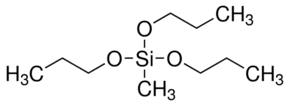
Methyl-tripropoxysilane
CH3Si(OCH2CH2CH3)3
Organometallic Reagents