
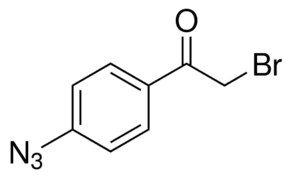
4-Azidophenacyl bromide
4-Azidophenacyl bromide (CAS: 57018-46-9; Formula: C8H6BrN3O; Molar Mass: 240.06 g/mol) is a photoactive, heterobifunctional cross-linking reagent. Supplied by Tech Serve Solutions, this compound facilitates specific coupling to sulfhydryl groups under mild conditions (pH 7.0-8.0). Upon UV irradiation (250 nm), it generates a reactive nitrene intermediate, enabling rapid, non-specific secondary bonding. It is primarily used in chemical biology and synthesis.
- IUPAC
- 4′-Azido-2-bromoacetophenone,4-Azido-α-bromoacetophenone
- Synonyms
- 4′-Azido-2-bromoacetophenone4-Azido-α-bromoacetophenone
Photoaffinity Labeling
Utilised in biochemical studies to identify binding partners of biomolecules. The azido group can be activated by UV light to form a reactive nitrene, which can covalently label nearby molecules.
Heterobifunctional Cross-linking
Enables the covalent linkage between two different molecules. It initially reacts with sulfhydryl groups and subsequently with other residues upon photoactivation.
Chemical Synthesis Building Block
Serves as a versatile intermediate in organic synthesis, particularly for introducing the azidophenacyl moiety into complex molecules.
Bioconjugation Chemistry
Applied in the conjugation of biomolecules, leveraging its dual reactivity for specific and non-specific binding strategies.
| Molecular weight | 240.06 |
|---|---|
| Empirical formula | C8H6BrN3O |
| Form | powder |
| Colour | yellow |
| Solubility | methanol: soluble50 mg/mL |
| Storage temperature | 2-8°C |
| Application | Photoactive, heterobifunctional cross-linking reagent. Typically, the initial reaction couples to sulfhydryl in the pH range 7.0-8.0. Second bonding occurs during UV irradiation (250 nm) via reactive nitrene. The latter bonding is rapid and non-specific. |


Hazard statements
- H228Flammable solid
- H314Causes severe skin burns and eye damage
- H317May cause an allergic skin reaction
- H334May cause allergy or asthma symptoms if inhaled
Precautionary statements
- P210Keep away from heat, sparks and open flames. No smoking
- P261Avoid breathing dust, fume, gas or vapours
- P280Wear protective gloves, clothing and eye/face protection
- P305IF IN EYES
- P310Immediately call a POISON CENTER or doctor
| Protective equipment | Eyeshields, Faceshields, full-face particle respirator type N100 (US), Gloves, respirator cartridge type N100 (US), type P1 (EN143) respirator filter, type P3 (EN 143) respirator cartridges |
|---|---|
| Transport (UN / ADR) | UN 1325 4.1 / PGII |
| Water hazard class (WGK, DE) | 3 |
| Hazard codes (EU) | F,C |
| Risk statements (R) | 11-34-42/43 |
| Safety statements (S) | 16-26-27-36/37/39-45 |
Hazard information is provided for guidance. Always consult the product Safety Data Sheet (SDS), available on request, before handling.
Documentation
Every batch ships with a Certificate of Analysis covering assay, identity and purity; the grade is confirmed against your enquiry. Safety Data Sheets and technical data sheets are available on request.
Supply & logistics
Samples for technical evaluation; bulk MOQ by grade and packaging. In-stock material ships in 7–10 working days, worldwide, with full export documentation.
What is 4-Azidophenacyl bromide used for?
+
4-Azidophenacyl bromide is primarily used as a photoactive, heterobifunctional cross-linking reagent in chemical biology and synthesis. It facilitates initial coupling to sulfhydryl groups, followed by non-specific secondary bonding upon UV irradiation.
What is the CAS number and formula for 4-Azidophenacyl bromide?
+
The CAS number is 57018-46-9 and the empirical formula is C8H6BrN3O.
What grade and purity does Tech Serve Solutions supply?
+
Tech Serve Solutions supplies 4-Azidophenacyl bromide as a research-grade chemical. The specific purity is detailed in the product specifications. We do not represent this product as USP, BP, or EP grade.
How should 4-Azidophenacyl bromide be handled safely?
+
Handling requires strict adherence to safety protocols due to its hazardous nature. Essential personal protective equipment includes eyeshields, face shields, gloves, and a suitable respirator. Refer to the safety data sheet for comprehensive handling instructions and hazard information, particularly regarding flammability (H228), severe skin burns and eye damage (H314), and respiratory sensitisation (H334).
How is 4-Azidophenacyl bromide packaged, shipped, and exported?
+
4-Azidophenacyl bromide is packaged according to international regulations for hazardous materials, specifically classified under UN 1325, Class 4.1, Packing Group II. We are experienced in exporting fine chemicals globally.
How can I request a sample or quote for 4-Azidophenacyl bromide?
+
To request a sample or a detailed quotation, please contact our sales team through the website or by direct inquiry, providing your specific requirements.
▶ Related products
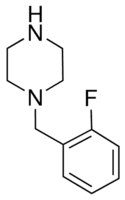
1-(2-Fluorobenzyl)piperazine
C11H15FN2
Chemical Synthesis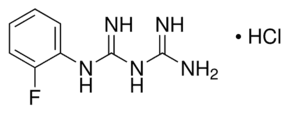
1-(2-Fluorophenyl)biguanide hydrochloride
Chemical Synthesis
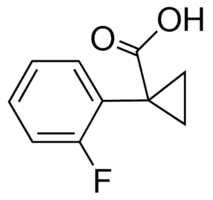
1-(2-Fluorophenyl)cyclopropanecarboxylic acid
C10H9FO2
Chemical Synthesis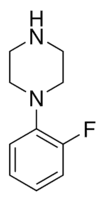
1-(2-Fluorophenyl)piperazine
C10H13FN2
Chemical Synthesis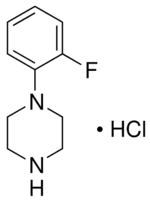
1-(2-Fluorophenyl)piperazine monohydrochloride
C10H13FN2 · HCl
Chemical Synthesis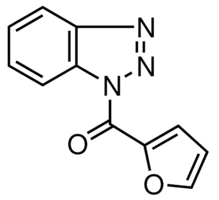
1-(2-Furoyl)-1H-benzotriazole
C11H7N3O2
Chemical Synthesis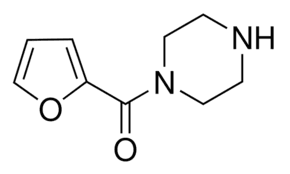
1-(2-Furoyl)piperazine
C9H12N2O2
Chemical Synthesis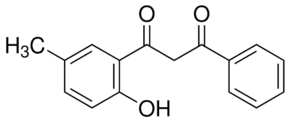
1-(2-Hydroxy-5-methylphenyl)-3-phenyl-1,3-propanedione
Chemical Synthesis
▶ Explore more

Bis(cyclopentadienyl)cobalt(III) hexafluorophosphate
C10H10CoF6P
Catalysis & Inorganic
1-(4-Chlorophenyl)biguanide hydrochloride
ClC6H4NHC(NH)NHC(NH)NH2 · HCl
Chemical Synthesis
Bis(cyclopentadienyl)dimethylzirconium(IV)
Catalysis & Inorganic

1-(4-Chlorophenyl)ethanol
ClC6H4CH(CH3)OH
Chemical Synthesis