
2-(Trimethylsilyl)ethoxymethyl-triphenylphosphonium chloride
2-(Trimethylsilyl)ethoxymethyl-triphenylphosphonium chloride (CAS 82495-75-8) is a phosphonium salt with the linear formula (CH3)3SiCH2CH2OCH2P(C6H5)3Cl and a molecular weight of 429.01 g/mol. Supplied at 98% purity, this compound serves as a valuable reagent in organic synthesis, particularly for C-C bond formation and olefination reactions. It is a key component in Wittig reactions and is utilised in the preparation of various complex organic molecules, including aldehydes and cyclic compounds.
- IUPAC
- SEM-triphenylphosphonium chloride
- Synonyms
- SEM-triphenylphosphonium chloride
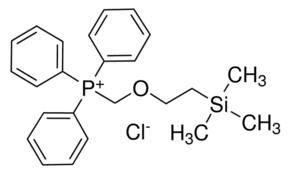
Wittig Reagent for Olefination
As a Wittig reagent, it facilitates the formation of carbon-carbon double bonds by reacting with aldehydes and ketones. This is a fundamental transformation in organic synthesis for preparing alkenes.
Aldehyde Homologation
This compound is employed in the preparation of aliphatic and alicyclic aldehydes through a homologation process, effectively extending the carbon chain of existing aldehydes.
Synthesis of Complex Organic Molecules
It is a reactant in multi-step syntheses, including the enantioselective synthesis of complex natural products like (-)-sarain A and the preparation of optically active bicyclic compounds.
C-C Bond Formation
Its utility extends to general C-C bond formation strategies, making it a versatile tool for constructing more complex molecular architectures in synthetic chemistry.
| Molecular weight | 429.01 |
|---|---|
| Linear formula | (CH3)3SiCH2CH2OCH2P(C6H5)3Cl |
| Assay | 98% |
| Application | Reactant for:• Enantioselective synthesis of (-)-sarain A using asymmetric Michael addition, cyclization, ring-closing metathesis, intramolecular Stille coupling, and late-state installation of tertiary amine-aldehyde proximity interaction1• Preparation of aliphatic and alicyclic aldehydes by homologation of aldehydes2• Wittig reactions3• Preparation of optically active (1S,5R)-(+)-3-azabicyclo[3.2.2]non-6-en-2-one via enantioselective intramolecular cyclopropanation4 |
| Melting point | 145-149 °C(lit.) |

Hazard statements
- H315Causes skin irritation
- H319Causes serious eye irritation
- H335May cause respiratory irritation
Precautionary statements
- P261Avoid breathing dust, fume, gas or vapours
- P305IF IN EYES
| Protective equipment | dust mask type N95 (US), Eyeshields, Gloves |
|---|---|
| Water hazard class (WGK, DE) | 3 |
| Hazard codes (EU) | Xi |
| Risk statements (R) | 36/37/38 |
| Safety statements (S) | 26-36 |
Hazard information is provided for guidance. Always consult the product Safety Data Sheet (SDS), available on request, before handling.
Documentation
Every batch ships with a Certificate of Analysis covering assay, identity and purity; the grade is confirmed against your enquiry. Safety Data Sheets and technical data sheets are available on request.
Supply & logistics
Samples for technical evaluation; bulk MOQ by grade and packaging. In-stock material ships in 7–10 working days, worldwide, with full export documentation.
What is 2-(Trimethylsilyl)ethoxymethyl-triphenylphosphonium chloride used for?
+
2-(Trimethylsilyl)ethoxymethyl-triphenylphosphonium chloride (CAS 82495-75-8) is used as a reactant in organic synthesis, primarily for C-C bond formation, olefination reactions (Wittig reactions), aldehyde homologation, and in the synthesis of complex organic molecules such as (-)-sarain A and optically active bicyclic compounds.
What is the CAS number and formula for 2-(Trimethylsilyl)ethoxymethyl-triphenylphosphonium chloride?
+
The CAS number is 82495-75-8 and the linear formula is (CH3)3SiCH2CH2OCH2P(C6H5)3Cl.
What grade and purity does Tech Serve Solutions supply?
+
Tech Serve Solutions supplies 2-(Trimethylsilyl)ethoxymethyl-triphenylphosphonium chloride with an assay of 98%. We do not represent this product as USP, BP, EP, or pharmacopoeia grade.
What are the safety and handling precautions for this chemical?
+
This compound is classified with GHS07 symbol and a Warning signal word, with hazard statements H315 (Causes skin irritation), H319 (Causes serious eye irritation), and H335 (May cause respiratory irritation). Recommended personal protective equipment includes a dust mask type N95 (US), eyeshields, and gloves. Handle in a well-ventilated area and avoid breathing dust.
How is this chemical packed, shipped, and exported?
+
Tech Serve Solutions handles packing and shipping with adherence to international regulations for chemical transport. We are experienced global suppliers and exporters of fine chemicals.
How can I request a sample or quote?
+
Please use the 'Request a Quote' or 'Contact Us' form on our website, providing the product name and CAS number, to request a sample or obtain a quotation.
▶ Related products
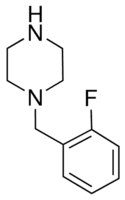
1-(2-Fluorobenzyl)piperazine
C11H15FN2
Chemical Synthesis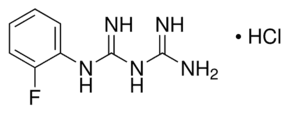
1-(2-Fluorophenyl)biguanide hydrochloride
Chemical Synthesis
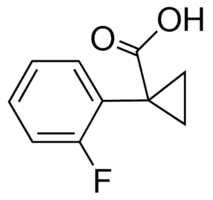
1-(2-Fluorophenyl)cyclopropanecarboxylic acid
C10H9FO2
Chemical Synthesis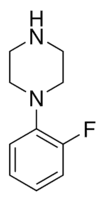
1-(2-Fluorophenyl)piperazine
C10H13FN2
Chemical Synthesis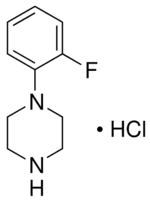
1-(2-Fluorophenyl)piperazine monohydrochloride
C10H13FN2 · HCl
Chemical Synthesis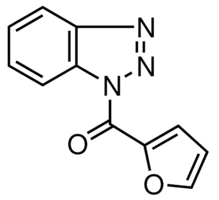
1-(2-Furoyl)-1H-benzotriazole
C11H7N3O2
Chemical Synthesis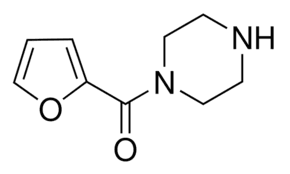
1-(2-Furoyl)piperazine
C9H12N2O2
Chemical Synthesis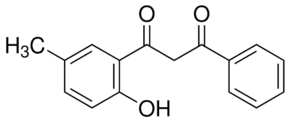
1-(2-Hydroxy-5-methylphenyl)-3-phenyl-1,3-propanedione
Chemical Synthesis
▶ Explore more

Bis(cyclopentadienyl)cobalt(III) hexafluorophosphate
C10H10CoF6P
Catalysis & Inorganic
1-(4-Chlorophenyl)biguanide hydrochloride
ClC6H4NHC(NH)NHC(NH)NH2 · HCl
Chemical Synthesis
Bis(cyclopentadienyl)dimethylzirconium(IV)
Catalysis & Inorganic

1-(4-Chlorophenyl)ethanol
ClC6H4CH(CH3)OH
Chemical Synthesis